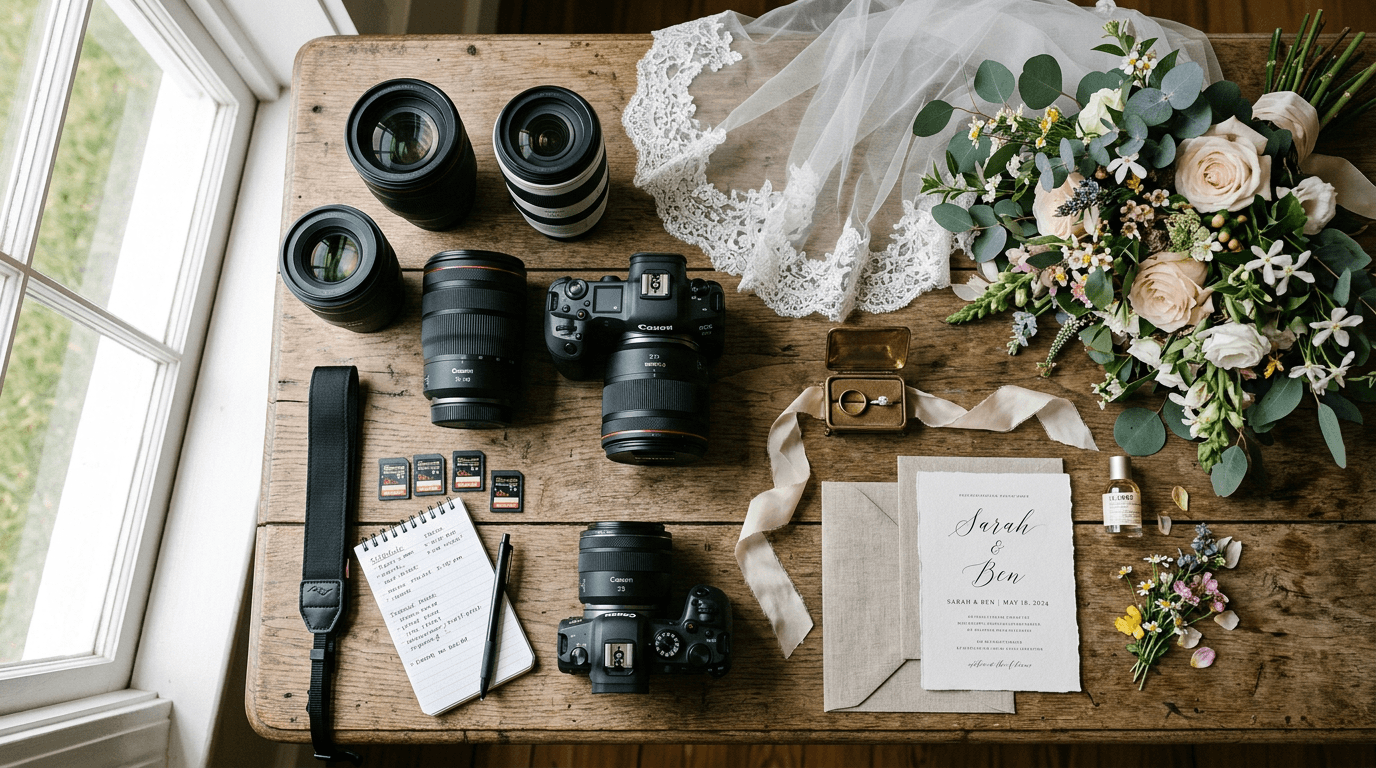
The best lenses for wedding photography in 2026 depend on your shooting style, your camera system, and how comfortable you are working close to your subjects — but a short list keeps coming up in every conversation: a 35mm or 50mm prime for intimate coverage, an 85mm or 100mm for portraits, and a 70-200mm zoom for the ceremony. That core kit handles nearly every situation a wedding day throws at you.
TL;DR
- A 35mm or 50mm prime is the most versatile single lens you can bring to a wedding — wide enough for groups, fast enough for low light, and small enough to carry all day.
- A 70-200mm f/2.8 zoom is close to essential for ceremony coverage and compressed portrait work, regardless of which prime you pair it with.
- New options in 2026 — especially the Tamron 35-150mm and Nikon Z 50mm f/1.2 — are reshaping what a “standard kit” looks like.
Best Lenses for Wedding Photography in 2026: What's Actually in Photographers' Bags
If you ask five working wedding photographers which lenses they'd take to a wedding tomorrow, you'll get five overlapping but slightly different answers. That's not a problem — it's a feature. Lens choice is deeply personal because it's inseparable from how you move, how close you get to your subjects, and what kind of images feel like yours.
What you will notice is that certain focal lengths keep appearing on every list, year after year. The gear changes — new mirrorless mounts, sharper glass, third-party options that are now genuinely professional-grade — but the focal lengths stay remarkably consistent. Let's break down why.
Prime Lenses: The Case for Fixed Focal Lengths
Prime lenses have a fixed focal length, which means if you want more or less in the frame, you move your feet. That sounds like a limitation, but it forces a level of intentionality that most photographers say makes them better at their craft.
On the practical side, primes tend to be cheaper than comparable zooms, lighter to carry across a 10-hour wedding day, and capable of wider maximum apertures — often f/1.2 to f/1.8 — which opens up creative possibilities that most zoom lenses simply can't match.
35mm — The Swiss Army Knife
The 35mm prime might be the single most recommended focal length for wedding photographers. It's wide enough for environmental shots and group formals, tight enough for individual portraits, and versatile enough that some photographers shoot entire weddings on nothing else.
On Canon, the RF 35mm f/1.4 is attracting serious attention. Sony shooters have the FE G-Master 35mm f/1.4 as a go-to, while Nikon's Z 35mm f/1.4 sits at a noticeably friendlier price point than the 35mm f/1.2 S — and many photographers prefer the rendering of the 1.4 anyway. The key trade-off: to get a close-up shot with a 35mm, you have to physically close the distance, which requires confidence in your ability to work near your subjects without making them self-conscious.
50mm — No Distortion, Pure Versatility
A 50mm prime produces almost no barrel distortion and sits close to the natural field of view of the human eye, which is why it translates so naturally into candid, documentary-style images. For photographers chasing the authentic, “you were there” feeling that couples increasingly request in 2026, the 50mm is a strong choice.
The Nikon Z 50mm f/1.2 has been getting consistent praise from wedding photographers this year. Taylor Jackson, a Canadian wedding photographer with over 1,100 weddings in his portfolio, highlighted it as a lens that “creates an image that surprises me every single time” — noting that he shoots it wide open at f/1.2 for almost everything except group shots. The Sony FE 50mm f/1.4 GM and Canon RF 50mm f/1.2 are the comparable choices on those systems.
85mm — The Portrait Specialist
Step up to 85mm and you gain meaningful working distance for portraits — you can create beautifully blurred backgrounds without crowding your subject. It's particularly useful for candid ceremony coverage from a side aisle or for individual portraits during the reception when you want separation between your subject and a busy background.
The downside is that group shots become difficult unless you have significant space to back up. Most photographers treat the 85mm as a secondary portrait lens rather than a primary workhorse, but for photographers who specialize in intimate elopements or portrait-heavy packages, it can become a main lens. Budget-friendly options like the Canon RF 85mm f/2 and Sony FE 85mm f/1.8 offer excellent image quality without the price tag of the flagship f/1.2 versions.
100mm — The Macro Option
The 100mm focal length occupies a niche but important role in a wedding kit. As a portrait lens, it produces lovely compressed results with soft backgrounds, but the reason most photographers carry one is for macro capability — ring shots, detail photographs of the invitation suite, floral details, and other close-up work that clients consistently love and request. The Canon RF 100mm f/2.8 Macro and Nikon Z 105mm f/2.8 Macro are the leading options on their respective systems.
Zoom Lenses: Flexibility When You Can't Move
Zoom lenses sacrifice maximum aperture in exchange for flexibility, and for many wedding scenarios — tight ceremony venues, unpredictable lighting, hybrid photo-video coverage — that trade-off is completely worth it. The two zooms that dominate wedding photography haven't changed much, but the versions available in 2026 are sharper and better-built than ever.
24-70mm f/2.8 — The All-Day Workhorse
A 24-70mm f/2.8 can technically cover a full wedding day on its own. At 24mm you capture wide ceremony scenes and full venue shots; at 70mm you have a solid portrait focal length with pleasing background separation. The constant f/2.8 aperture handles most indoor lighting conditions without flash, and the range means fewer lens changes in chaotic moments.
Canon's RF 24-70mm f/2.8 and Sony's FE 24-70mm GM II are the premium options, while the Nikon Z 24-70mm f/2.8 S is equally well-regarded. Photographers who shoot hybrid photo-video coverage often build their entire kit around this focal range because a sliding aperture zoom creates problems for video exposure — and a constant f/2.8 eliminates that variable entirely.
70-200mm f/2.8 — The Ceremony Essential
If there's one lens that comes closest to universal agreement among wedding photographers, it's the 70-200mm f/2.8. At 200mm you can fill the frame with the couple's faces during the vows while standing at the back of the venue, which means less distraction and more genuine emotion in your frames. Compressed background blur at this focal length is also flattering for both individual portraits and full group shots when space allows.
The Canon RF 70-200mm f/2.8 L, Sony FE 70-200mm f/2.8 GM OSS II, and Nikon Z 70-200mm f/2.8 S are all excellent. The Fujifilm XF 50-140mm f/2.8 covers equivalent reach on APS-C bodies. The main downside is weight — this is a heavy lens, and by hour eight of a wedding day, that matters.
The Lens Getting Everyone's Attention Right Now: Tamron 35-150mm
One of the most discussed lenses in wedding photography communities heading into 2026 is the Tamron 35-150mm f/2-2.8. It covers a range that essentially replaces a 35mm prime and a 70-200mm zoom in a single barrel — useful for photographers who are also shooting hybrid video and need to minimize gear changes mid-coverage.
Taylor Jackson noted that a newer variant, the Tamron 35-100mm f/2.8, is now in his hands and may replace the 35-150 in his kit — primarily because the constant f/2.8 aperture solves the sliding-aperture problem for video shooters. Third-party glass has shed its reputation for being “unprofessional” and options like these are genuinely competitive with first-party lenses at a fraction of the cost.
The Fisheye and Ultra-Wide Trend: Gimmick or Genuine?
Wedding photography trends in 2026 are leaning hard toward authenticity and immersion — documentary coverage, direct flash, true-to-color editing. Ultra-wide lenses fit that aesthetic well when used intentionally. Kari Bjorn, a Connecticut-based wedding photographer, notes that the fisheye-adjacent look is emerging partly because younger couples grew up using the 0.5x wide mode on their iPhones and associate it with real, in-the-moment energy.
A 20mm or 28mm prime achieves a similar feeling without full fisheye distortion. Canon's RF 28mm f/2.8 — a compact, affordable pancake-style lens — is appearing in more and more wedding kits as a lightweight candid option that's easy to drop into a bag without adding meaningful bulk. The trade-off is that ultra-wide shooting requires genuine proximity to your subjects, which demands confidence and social awareness on the dance floor.
For more on how the documentary and authentic aesthetic is shaping what couples want delivered after the day, see our piece on raw vs. polished wedding photography trends and our deeper look at the film wedding photography trend in 2026.
How to Build Your Lens Kit by Shooting Style
There's no single right answer, but there are logical starting points depending on how you work.
If you're comfortable getting close to your subjects: A 35mm or 20mm prime as your primary lens, backed by a 70-200mm for ceremonies, gives you an immersive, distinctive look that zooms simply can't replicate. You'll need to be physically present in the action — at the table during dinner, on the dance floor during the first dance — which produces remarkable images but requires a specific kind of energy and confidence.
If you prefer maintaining distance: A 24-70mm f/2.8 lets you stay back and still capture wide scenes and decent portraits. Pair it with a 70-200mm and you have full coverage of every wedding moment without needing to crowd anyone. This is the kit that minimizes logistics and maximizes flexibility.
If you shoot hybrid photo-video: The Tamron 35-150mm or 35-100mm offers a compelling single-lens solution for run-and-gun coverage where switching glass mid-video is impractical. Add a fast 50mm prime for low-light receptions and you're well-covered.
Whatever system you shoot, almost every working wedding photographer agrees on one thing: bring a 70-200mm. There are shots that lens enables — emotional ceremony close-ups, compressed couple portraits against a sweeping background — that no other lens in your bag can produce. It's worth the weight.
If you're also evaluating the editing and culling software side of your workflow, our guide to photo editing and culling tools for 2026 covers the tools that pair best with high-volume wedding shooting. And if you're looking at the full business picture, including how gear choices affect your workflow from shoot to delivery, the wedding photographer business playbook is worth a read.
After the Shoot: Getting Your Photos to Every Guest
The best lens kit in the world only matters if couples and their guests actually see the photos you work so hard to capture. Most wedding galleries get viewed by the couple and a handful of close family — but the 150+ guests who attended that wedding have no easy way to find the photos they're in. That's a missed opportunity for you and a frustrating gap for guests.
FindMe Photo solves exactly that problem. Guests scan a QR code, take a quick selfie, and AI face recognition instantly surfaces every photo they appear in — from your full gallery, delivered directly to their phone. Couples love it, guests share the images widely, and your work reaches the audience it deserves. Try FindMe Photo free and see how it transforms wedding photo delivery.
Frequently asked questions
What is the best single lens for wedding photography in 2026?
Most working photographers point to the 35mm prime as the most versatile single lens for weddings. It handles portraits, group shots, getting-ready coverage, and reception candids without forcing you to switch glass constantly. If you shoot Nikon mirrorless, the 35mm f/1.4 is a current favourite. Canon and Sony shooters have equally strong native options at that focal length.
Should I use prime or zoom lenses for wedding photography?
Both work well, and many photographers mix the two. Primes give you wider maximum apertures, lighter weight per lens, and lower cost — but they require you to move around more. Zooms like the 24-70mm f/2.8 offer flexibility in tight spaces where you can't reposition. A common hybrid kit is a 35mm or 50mm prime alongside a 70-200mm zoom.
Is a 70-200mm lens worth it for weddings?
Yes — almost universally. The 70-200mm f/2.8 lets you fill the frame with the couple during the ceremony without standing at the altar, capture genuine emotion on faces from a comfortable distance, and shoot flattering compressed portraits. It's heavy, but most photographers consider it non-negotiable in their bag.
What lenses do wedding photographers use for low light?
Wide-aperture primes are the go-to for low-light wedding situations — think f/1.2 to f/1.8 options at 35mm, 50mm, or 85mm. The Nikon Z 50mm f/1.2 and Sony FE 50mm f/1.4 GM are getting a lot of attention in 2026. For photographers who prefer zooms, pairing a 24-70mm f/2.8 with a well-placed flash covers most reception scenarios.
Are fisheye or ultra-wide lenses a real trend for weddings in 2026?
Ultra-wide lenses — including the occasional fisheye — are gaining traction in 2026, partly driven by younger couples who love the immersive 0.5x look from smartphone cameras. A 20mm or 28mm prime can produce the same feeling of being inside the action. It's not for every photographer or every wedding, but used intentionally it adds a distinctive, editorial energy to a gallery.
Browse by topic
The new photo gallery for pro event photographers.
Expand your reach: 10× more guests open your galleries.
Why the whole room opens it
One link per event. No signup, no login, no app for your guests. Designed for mobile and access on the go.

Their face is their password. A selfie finds their photos in under 2 seconds. Selfie Search comes in every plan, including Free+.
They share it, or buy from your store. Your prices, your brand, your customers. Set up your store for digital and/or print copies connected to your Stripe.
Open your Free+ account today, with the top premium features included, and onboard the fastest, coolest way to share your galleries.