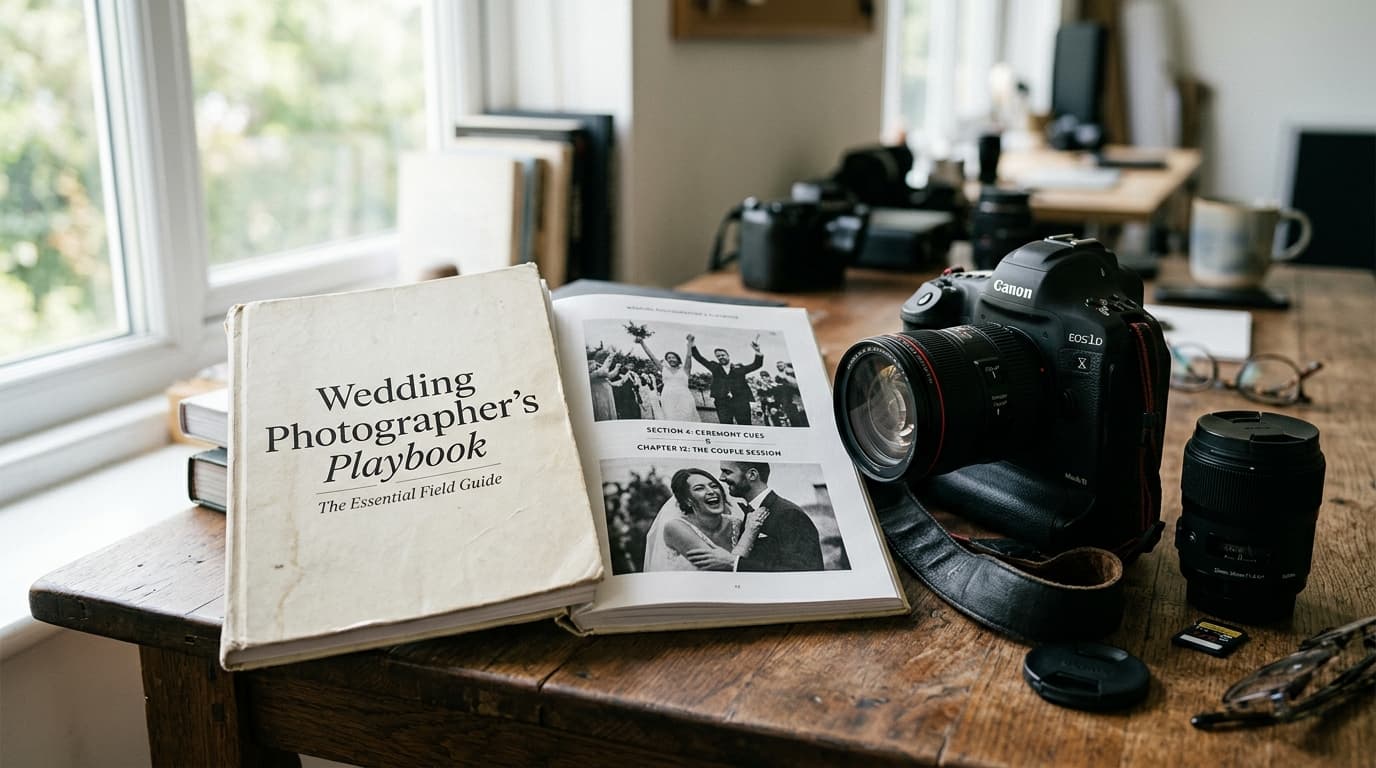
A solid wedding photographer business playbook covers five core areas: pricing your work correctly, building a repeatable shooting and editing workflow, delivering photos in a way that generates referrals, maintaining strong relationships with planners and venues, and choosing the right tools to support all of the above. Get those five things working together and the business side of photography stops feeling like a grind.
TL;DR
- Price based on your actual costs and market position — not what you think couples want to hear.
- A repeatable post-production workflow is the difference between a sustainable business and a burnout spiral.
- The way you deliver photos to guests is a marketing channel in itself — treat it like one.
The Wedding Photographer Business Playbook: Five Areas That Actually Move the Needle
Most photographers start their business by focusing almost entirely on shooting. That's understandable — it's what you love. But the photographers who build genuinely sustainable, profitable businesses treat every part of the operation with the same attention they give their craft. Here's what that looks like in practice.
1. Pricing: Stop Guessing and Start Calculating
Pricing is the area where more photographers leave money on the table than anywhere else. The temptation to match the lowest competitor in your market or to avoid "scaring off" couples with high numbers costs you real income year after year.
Start by calculating your actual cost of doing business: gear depreciation, software subscriptions, insurance, marketing spend, and the hours you spend on every single wedding — not just shooting, but emailing, editing, culling, and delivering. Once you know your floor, you can price above it with confidence instead of anxiety.
Packages should reflect what you actually want to sell. If you hate doing video, don't offer it just because a competitor does. Build your tiers around your strengths, and price your add-ons — albums, additional hours, engagement sessions — in a way that makes upselling feel natural rather than pushy.
Understanding what couples in the US actually budget for photography gives you a useful benchmark, but don't let averages anchor you below where your work deserves to sit.
2. Booking: Where Your Next Client Is Actually Coming From
Wedding photographers who consistently fill their calendar aren't usually the ones running the most Instagram ads. They're the ones who've built a referral engine that runs quietly in the background of every wedding they shoot.
Wedding planners are your single most valuable referral source. A planner who trusts you will recommend you to every couple they work with — that's potentially dozens of bookings from one relationship. Understanding how planners actually decide which photographers to recommend is essential reading if you want to crack that channel.
Your other underused referral source is the wedding guests themselves. There are typically 100–200 people at every wedding you shoot, many of whom will get married themselves or know someone who will. If they see your work, experience how easy you are to work with, and can actually find their own photos without jumping through hoops, you're planting seeds for future bookings at every event.
Your Google presence matters too. Couples search for photographers in their area before they ask friends for recommendations, so investing time in your local SEO — specifically how to rank on Google as a wedding photographer — compounds over time in a way that paid ads don't.
3. Shooting Day: Building a System That Holds Up Under Pressure
The best photographers are also excellent logisticians. A chaotic shooting day produces chaotic results — missed moments, stressed couples, and a post-production queue that feels overwhelming before you've even started editing.
Build a pre-wedding questionnaire that forces you to gather everything you need: a detailed timeline, a list of must-have formal shots, the names of key family members, and any logistical quirks about the venue. Send it three to four weeks before the date so you have time to follow up on gaps.
On the day itself, your job is to be the calmest person in the room. Couples take emotional cues from their photographer. If you're visibly stressed about light or timing, they feel it. Build buffer time into every segment of the day, and communicate clearly with the planner and officiant rather than silently hoping things run on schedule.
Card management and backup habits are non-negotiable. Shoot to dual cards whenever your body allows it, and back up to at least two separate drives before you go to sleep on wedding night. Hard drives fail. The photographers who lose client images and stay in business are almost zero.
4. Post-Production: Speed and Consistency Are Your Competitive Advantage
The editing phase is where a lot of photographers lose hours they can't get back. A chaotic culling and editing process means slower deliveries, more client anxiety, and less time to pursue new bookings or actually rest between weddings.
AI culling tools have changed this equation dramatically. Platforms like Aftershoot, Narrative, and others can cut your culling time by 60–80% without sacrificing the final selection quality — meaning you can move from 3,000 raw images to a curated edit-ready set in a fraction of the time it used to take. Comparing the top AI culling tools is worth doing before you commit to one.
Consistency in your editing style is what makes your portfolio coherent and your brand recognizable. Develop a core preset that represents your look, then adjust per wedding for the specific light conditions rather than starting from scratch every time. Export at consistent settings so your galleries always look right on every device.
Faster delivery also has a direct marketing benefit. When photos arrive while couples and guests are still riding the emotional high of the wedding, they share them. Shares generate inquiries. There's a real business case for why delivering wedding photos within 48 hours of the event — or at least delivering a preview set — outperforms a six-week wait in almost every measurable way.
5. Delivery: Turn Your Gallery Into a Referral Machine
Most photographers treat photo delivery as the end of the workflow. The smart ones treat it as the beginning of their marketing for the next wedding.
The standard approach — send the couple a gallery link and let them forward it to family — leaves enormous value on the table. The average wedding guest never sees the photographer's best work because they rely on the couple to share it, and couples are busy, exhausted, and dealing with post-wedding life.
A better approach is to make the gallery directly accessible to every guest at the reception. QR codes placed on tables or displayed at the venue entrance give every guest instant access. But even better is giving guests a way to find their own photos specifically — because people share photos of themselves far more than photos of strangers.
This is exactly where AI face search technology changes the game. When a guest can take a quick selfie and instantly pull up every photo they appear in from the entire wedding gallery, they're not just happy — they're delighted. And delighted guests share. That sharing exposes your work to their entire network, including future couples who didn't even attend the wedding.
If you want to go deeper on how to set this up effectively, the QR code playbook for wedding photographers covers the logistics in detail.
6. Tools: Build Your Stack Intentionally
There's no shortage of software competing for your subscription dollars, and the wrong stack can add cost and complexity without improving your output. The right stack should handle four things cleanly: client communication and contracts, photo culling and editing, gallery delivery, and business finances.
For client communication, a CRM like Honeybook or Studio Ninja automates your booking flow, sends contract reminders, and manages invoicing without you having to chase anyone down. For culling and editing, pick one AI culling tool and one editing suite and stick with them long enough to get fast. Switching constantly resets your learning curve.
For gallery delivery, evaluate platforms not just on how they look to the couple, but on how accessible they are to guests. Watch out for hidden fees on delivery platforms — some charge per-gallery or per-download fees that erode your margins, especially if you're shooting high volume.
For finances, use actual accounting software from day one. Mixing personal and business finances is a tax headache you don't need, and not knowing your real profit margins makes pricing decisions guesswork.
The Compounding Effect: When All Five Systems Work Together
The real insight behind any working wedding photographer's playbook is that none of these systems exist in isolation. Your pricing funds better gear and software. Better software speeds up delivery. Faster delivery generates more guest engagement. More guest engagement drives referrals. More referrals give you leverage to raise your prices. The whole loop reinforces itself when each piece is working.
Photographers who feel stuck — grinding through busy season without growing their revenue or their reputation — are almost always missing one of these five pillars. Fix the weakest link first, and you'll feel the difference across the whole operation.
It also helps to be honest about which parts of the business you actually enjoy versus which parts you're tolerating. If editing is your least favourite thing, invest in tools that minimize the time you spend on it. If you love the relationship side, invest in the referral and delivery experience because that's where your energy translates directly into business growth.
What the Best Working Photographers Have in Common
After talking to hundreds of photographers across different markets and price points, a few patterns show up consistently among the ones who build thriving businesses rather than just busy ones.
They raise their prices regularly — not dramatically, but incrementally, and without apologizing for it. They invest in their referral relationships with planners and venues as seriously as they invest in their camera gear. They deliver photos in a way that makes every guest feel like a VIP, not just the couple. And they review what's working in their business at least once a quarter rather than just putting their head down and shooting.
None of this is complicated in theory. It just requires treating your photography business like a business, not a side project that happens to pay your bills.
Ready to turn your delivery experience into a referral engine? FindMe Photo gives every wedding guest instant access to their own photos via AI face search and QR codes — so your work reaches every person in that room, not just the couple. It's the easiest upgrade to the back end of your workflow with the biggest front-end marketing impact. See how it works at findme.photo.
Frequently asked questions
How much should a wedding photographer charge in 2026?
Pricing varies by market, experience, and deliverables, but most full-time wedding photographers charge between $2,500 and $6,000 for a single-day package in the US. Factor in your editing time, travel, gear costs, software subscriptions, and the value of fast delivery when setting your rate. Undercharging is one of the fastest ways to burn out.
How do wedding photographers get more referrals?
The most reliable referral sources are wedding planners, venues, and past clients. Build genuine relationships with planners by making their job easier on the day and tagging them in your social content. For guest referrals, make it dead simple for everyone at the reception to find and share photos — tools like QR codes and AI face search dramatically increase the number of guests who actually see your work.
What software do wedding photographers use to deliver photos?
Popular gallery platforms include Pixieset, ShootProof, and Pic-Time. A growing number of photographers are also adding tools like FindMe Photo, which lets every wedding guest find their own photos instantly via AI face search and QR codes — turning passive galleries into active referral engines.
How long does it take to deliver wedding photos to clients?
Industry expectations have shifted significantly. While a 6–8 week turnaround was once standard, many photographers now target 2–4 weeks, and some deliver sneak peeks within 48 hours. Faster delivery leads to more social sharing while the excitement is still fresh, which directly benefits your word-of-mouth marketing.
How do wedding photographers stay organized during busy season?
A repeatable workflow is everything. Use a CRM to automate client communications, batch your editing sessions rather than tackling each wedding piecemeal, and standardize your culling process with AI tools. Create checklists for pre-wedding, day-of, and post-production phases so nothing slips through the cracks when you're shooting every weekend.
Browse by topic
The new photo gallery for pro event photographers.
Expand your reach: 10× more guests open your galleries.
Why the whole room opens it
One link per event. No signup, no login, no app for your guests. Designed for mobile and access on the go.

Their face is their password. A selfie finds their photos in under 2 seconds. Selfie Search comes in every plan, including Free+.
They share it, or buy from your store. Your prices, your brand, your customers. Set up your store for digital and/or print copies connected to your Stripe.
Open your Free+ account today — every Growth feature free for 30 days — and onboard the fastest, coolest way to share your galleries.