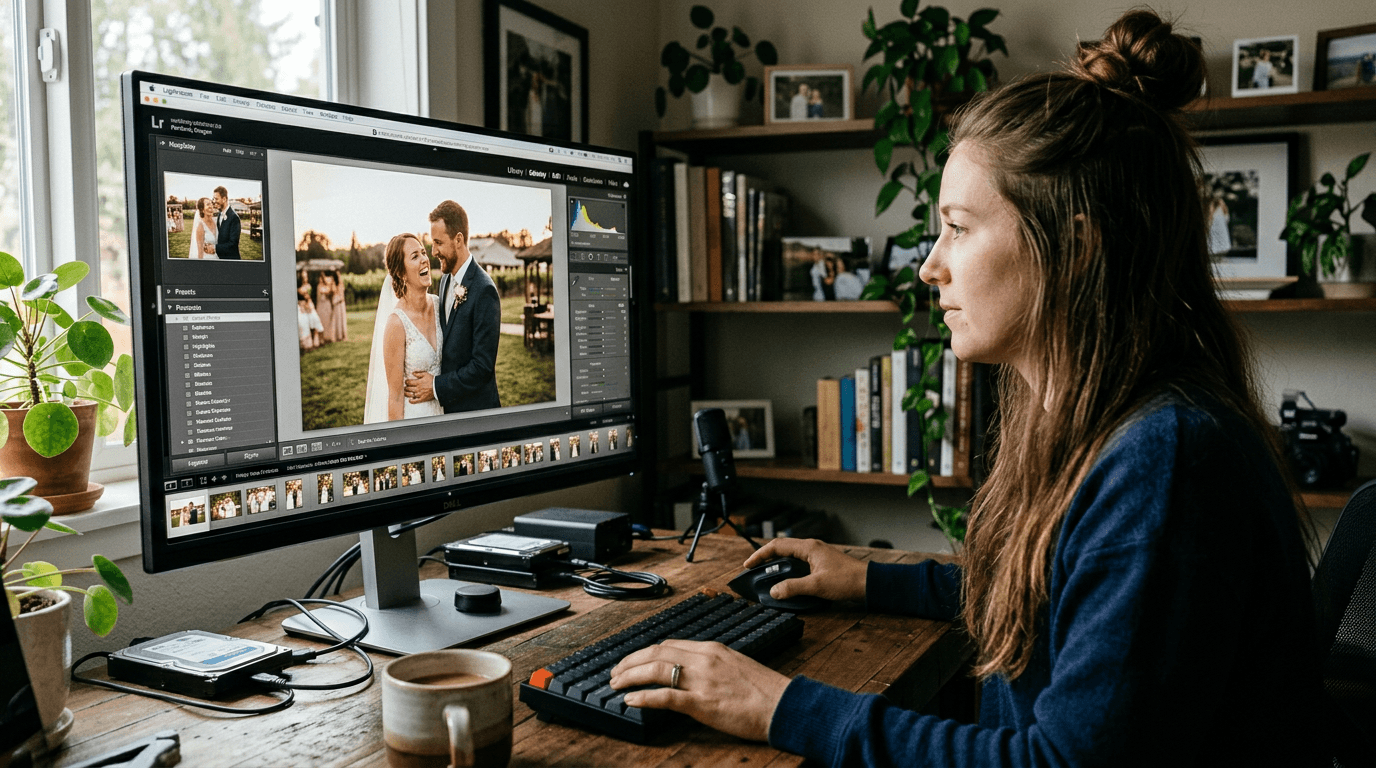
What couples want from wedding photography has shifted more in the last three years than in the previous decade. If clients are arriving at consultations with film-inspired Pinterest boards, requests for “candid and unposed,” or a specific ask for “true-to-color editing,” you're not imagining it. The pendulum has swung hard away from the heavy-preset, overly curated look — and understanding exactly where it's landed will help you position your work, your portfolio, and your editing workflow more effectively.
TL;DR
- Couples in 2025 are overwhelmingly requesting documentary, candid, and true-to-color work over heavily filtered or staged photography.
- Your editing software and workflow choices directly affect whether you can deliver what couples are asking for — Lightroom and Capture One handle color science differently, and that gap matters for true-to-color work.
- Delivering photos that guests can actually find and share — not just a polished gallery the couple scrolls through alone — is the next competitive edge, and tools like FindMe Photo make that effortless.
What Couples Want From Wedding Photography: The Shift That's Already Happened
For most of the 2010s, the dominant wedding photography aesthetic was unmistakable: desaturated greens, lifted shadows, blown-out whites, and a matte finish that made every image look like it was shot through a faded Instagram filter. It was polished, it was consistent, and for a while, it was exactly what couples wanted. That era is effectively over.
According to wedding industry trend reporting published by Emerie Leigh Photography in December 2024, the photography trends for 2025 are anticipated to focus on “a blend of authenticity and creativity, emphasizing candid moments and personalized storytelling” and a rise in “true-to-color editing” that preserves the vibrancy of colors as they actually appeared on the day (el.photos, December 21, 2024). That's not a niche preference — it's the mainstream.
What's driving this? A few things are happening at once, and they're all reinforcing each other.
Why Couples Are Choosing the Raw, Documentary Aesthetic
The biggest cultural force behind this shift is a broad rejection of artificiality. Couples who grew up watching their parents' wedding videos and photos have an intuitive sense of what feels “performed” versus what feels real. They've also spent years consuming documentary-style content on social media — raw, unfiltered, in-the-moment — and that's recalibrated what “beautiful” means to them.
Wedding photographers on the ground are reporting the same thing. Multiple photographers surveyed for the 2025 Orlando wedding trends roundup noted that couples are “leaning heavier into documentary-style photography” and specifically want their photographers to “blend into the background and capture those candid moments as their day unfolds” (weddingvenuemap.com, December 23, 2024). The ask isn't to eliminate posed portraits — it's to make them a smaller percentage of the total gallery.
There's also a film photography revival feeding into this. Couples are drawn to the warmth, grain, and deliberate quality of 35mm and medium format film because it feels more intentional and more personal than a digitally perfect image. Even photographers who shoot entirely on digital are responding by adopting film-emulation presets and a more restrained approach to retouching — letting texture, shadow, and imperfection stay in the frame rather than editing them out.
What This Means for Your Editing Workflow and Tools
This is where the aesthetic shift gets practical. True-to-color editing is not the same as dropping a preset on a batch and exporting. It requires deliberate decisions about white balance, skin tone accuracy, and how the colors in the scene actually related to each other on the day. That takes more time and more skill — but it also means the right editing tools matter more than they used to.
Lightroom remains the industry default, and for good reason: it's fast, it integrates with most culling tools, and its AI-powered masking in recent versions has made selective adjustments significantly faster. For true-to-color work, the new Point Color tool (introduced in Lightroom Classic 13.0) lets you target individual hues with precision — useful when you need to correct a venue's tungsten cast without blowing out the florals.
Capture One has a different color philosophy entirely. Its color editor works in a way that feels more intuitive for photographers chasing accuracy — you can adjust hue, saturation, and lightness for specific color ranges without the bleed-over that Lightroom's HSL panel sometimes produces. Many photographers who switched to Capture One specifically cite skin tone accuracy as the deciding factor. Our full comparison of Lightroom vs Capture One in 2026 breaks down exactly how the color science differs between the two.
Photoshop still has a role, particularly for portrait retouching where you need frequency separation or precise healing work. But for true-to-color wedding editing, most photographers are doing the heavy lifting in Lightroom or Capture One and only moving to Photoshop for specific problem images — a distracting background element, a blink that needs compositing, or a complex skin correction that the AI tools in Lightroom can't handle cleanly.
The documentary style also means you're delivering more images. Fewer moments are being cut because “it's not posed enough” — candid reactions, in-between moments, and quiet details all belong in the gallery now. That volume increase makes a smart culling strategy non-negotiable. Our guide to AI culling for wedding photography covers how to reclaim hours on the front end so you have more time for intentional color work.
The Polished Aesthetic Isn't Dead — It's Just Evolved
It's worth being precise here: couples aren't rejecting quality. They're rejecting artificiality. The polished aesthetic that's falling out of favour is the one that prioritises technical perfection over emotional truth — stiff poses, skin smoothed beyond recognition, colours so manipulated they bear no resemblance to the actual venue lighting.
What's replacing it isn't chaos. Photographers like Kizzy at Contempo Photos describe the emerging sweet spot as “authentic and editorial-style shots that feel spontaneous but refined. Clean and minimalistic backdrops and soft lighting that look natural achieve that magazine look” (weddingvenuemap.com, December 23, 2024). That's a sophisticated brief — it requires just as much technical skill as the old polished approach, but the goal is invisible craft rather than visible perfection.
High-fashion bridal portraits are also still very much in demand, particularly for couples who want a handful of images that feel genuinely editorial. The difference is that those shots now live alongside a much larger body of candid, documentary work rather than dominating the gallery. Think of it as a 70/30 split that used to be 30/70.
How to Talk About Editing Style in Consultations
The practical challenge for most photographers isn't understanding the trend — it's translating it into a conversation that actually helps you book the right clients and set accurate expectations with everyone else.
Start by asking couples to show you galleries they've saved, not just describe what they want in words. “Natural and candid” means something very different to a couple who's been saving dark, moody film work versus one who's been saving bright, airy documentary images. The visual reference cuts through the ambiguity immediately.
When couples say they want it to “feel real,” follow up with specifics: Do they want grain? Are they comfortable with imperfect expressions if the emotion is genuine? How do they feel about motion blur on the dance floor? These aren't trick questions — they're the details that determine whether a client loves or is disappointed by a gallery that's technically consistent with what they asked for.
It's also worth being honest about what you do best. If your natural instinct is toward a more editorial, controlled aesthetic, don't oversell a documentary approach just to book the job. Couples who want raw and unscripted will feel the mismatch in the final gallery, and that affects reviews, referrals, and rebookings.
The Delivery Side of the Shift
Here's something that doesn't get discussed enough: what couples want from wedding photography has changed not just in terms of how photos look, but how they want to experience receiving them. A gallery of 800 candid, documentary images is only valuable if guests can actually find themselves in it. A couple might love their full gallery — but their 120 wedding guests are going to open the link, scroll for thirty seconds, give up, and never engage with it again.
That's a missed opportunity for you as a photographer. Every guest who finds a photo of themselves and shares it is a referral engine. Every guest who can't find themselves in a 700-image gallery is a dead end. This is exactly the problem that delivering wedding photos to guests via AI face search solves — guests upload a selfie, the platform finds every photo they appear in, and suddenly a 700-image gallery becomes personally relevant to every single person at the wedding.
The shift toward more candid, documentary coverage actually makes this more important, not less. When you're shooting 600+ images across a full day of unscripted moments, the traditional gallery experience — scroll and hope — doesn't scale. And if you're curious about how AI face recognition actually works in a wedding context, our explainer on AI selfie photo search walks through the mechanics in plain language.
Positioning Your Portfolio for What Couples Actually Want
If you've been shooting documentary-leaning work for years but your website still leads with your most polished, heavily retouched portraits, you're attracting the wrong clients and confusing the right ones. Your portfolio needs to reflect the aesthetic you actually deliver — and right now, that means leading with candid emotion, true-to-color editing, and the kind of unguarded moments that couples are specifically seeking out.
Update your featured galleries to show full sequences, not just hero shots. A series of five images from the same emotional moment — the approach, the reaction, the embrace, the laugh, the quiet after — communicates documentary authenticity far more effectively than one technically perfect portrait. It also shows couples that you were present and attentive throughout the day, not just set up for the obvious shots.
Think carefully about how you're sharing galleries with past clients, too. If guests from previous weddings can find and download their photos easily, they're more likely to post them, tag the photographer, and send their friends your way. Our breakdown of the 48-hour wedding photo delivery window covers why speed and accessibility in delivery directly affects how much social traction your work gets.
The Bottom Line
What couples want from wedding photography in 2025 is clear: authenticity, true-to-color accuracy, and a gallery that feels like a genuine record of their day. The photographers who adapt their portfolios, their editing workflows, and their client conversations to reflect this will book more of the right clients. The ones who don't will keep attracting couples who feel slightly disappointed by galleries that don't quite match what they envisioned — even when the work is technically excellent.
The aesthetic shift is also an opportunity. Documentary coverage means more images, more moments, more guests appearing in the gallery — and more reasons for every person at that wedding to engage with your work, share it, and remember your name when their friends get engaged.
Ready to make sure every guest at every wedding can find and share their photos? FindMe Photo lets guests search the full wedding gallery using just a selfie — powered by AI face recognition, no app download required. It's the simplest way to turn a 700-image documentary gallery into a personal experience for every single guest. See how FindMe Photo works for wedding photographers.
Frequently asked questions
What do couples want from wedding photography in 2025?
Most couples in 2025 want documentary-style coverage, true-to-color editing, and a gallery that feels like an honest record of the day — not a heavily filtered or staged highlight reel. They still expect a handful of polished portraits, but the majority of the gallery should feel candid and unscripted.
What editing style do most wedding couples want in 2025?
True-to-color editing is the dominant preference. Couples want accurate skin tones, vibrant florals, and natural shadows — not the desaturated, matte, lifted-shadow look that dominated the early 2010s. Tools like Lightroom and Capture One both support this approach, but they handle color science differently, which matters when you're chasing accuracy.
What is the difference between raw and polished wedding photography?
Raw wedding photography prioritizes unscripted moments, natural light, minimal retouching, and an aesthetic that feels close to how the day actually looked — grain, imperfections and all. Polished wedding photography uses deliberate posing, controlled lighting, and a refined editing style to create a more curated, magazine-ready result.
Is film or digital better for wedding photography in 2025?
Neither is objectively better — it depends on what the couple values. Film offers warmth, grain, and a deliberate quality many couples are actively requesting. Digital gives you flexibility, consistency, and faster delivery. Many photographers now shoot digital with a film-emulation edit in Lightroom or Capture One, which satisfies both camps.
How should wedding photographers adapt to changing aesthetic preferences?
Ask every inquiry to show you galleries they've saved on Instagram or Pinterest — not just describe what they want in words. That one question tells you more about their aesthetic than any questionnaire. Then make sure your portfolio reflects the style you actually shoot. If you're pivoting toward documentary work, update your featured galleries before you start marketing it.
Browse by topic
The new photo gallery for pro event photographers.
Expand your reach: 10× more guests open your galleries.
Why the whole room opens it
One link per event. No signup, no login, no app for your guests. Designed for mobile and access on the go.

Their face is their password. A selfie finds their photos in under 2 seconds. Selfie Search comes in every plan, including Free+.
They share it, or buy from your store. Your prices, your brand, your customers. Set up your store for digital and/or print copies connected to your Stripe.
Open your Free+ account today, with the top premium features included, and onboard the fastest, coolest way to share your galleries.