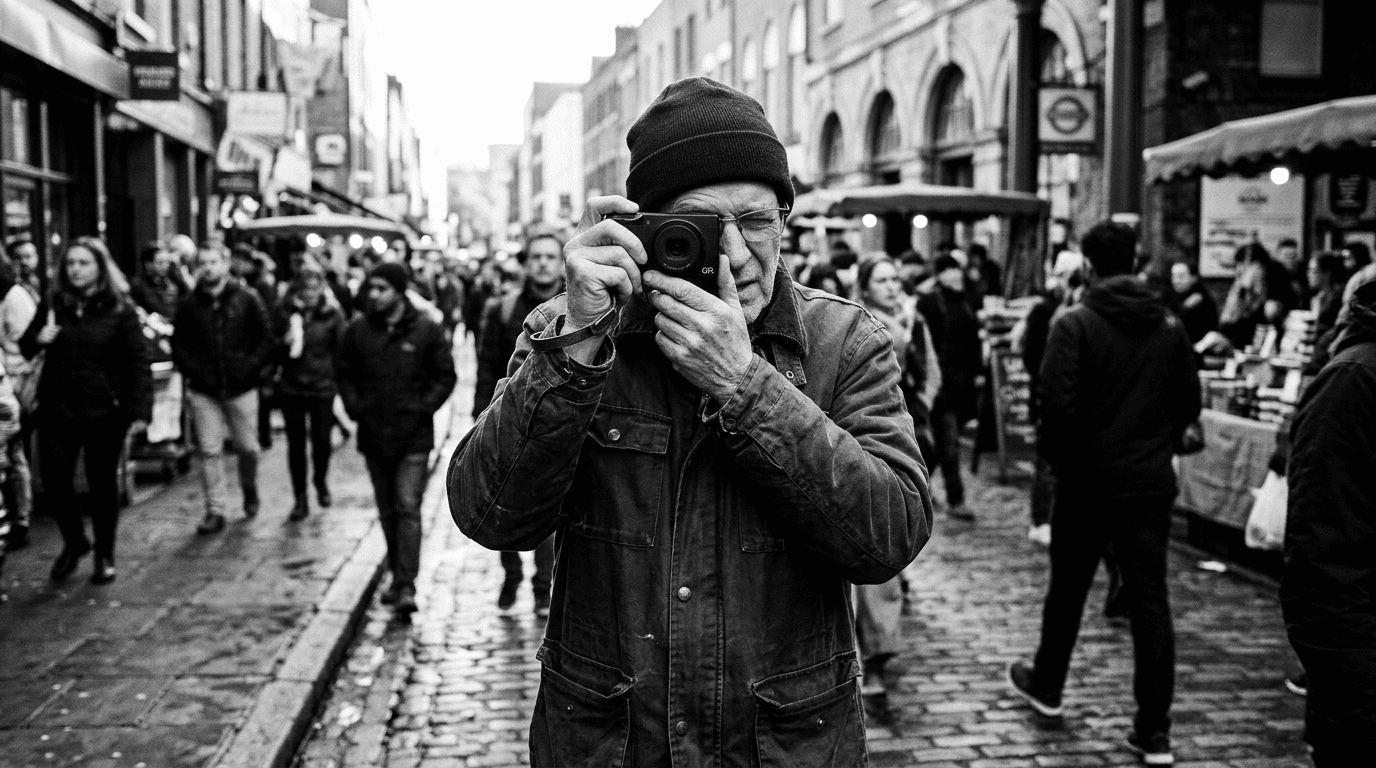
The Ricoh GR III Monochrom is worth it if you shoot street, documentary, or personal work and want a camera that removes color as a decision entirely. It is not worth it if you deliver client galleries in color, because the sensor never records color data and there is no undoing that in post.
TL;DR
- The Ricoh GR III Monochrom strips the Bayer color filter from a standard GR III sensor, trading color for sharper detail and a JPEG-first, high-contrast workflow.
- Photographers who have tested it report faster culling, smaller files, and a creative constraint that pushes them to shoot more instinctively.
- For event photographers shooting weddings, corporate work, or sports, it works best as a personal or second-body tool, not a replacement for the color files clients expect from a gallery.
Is the Ricoh GR III Monochrom Worth It in 2026?
Yes, for photographers who already shoot a lot of black and white and want the sharpest, cleanest monochrome files a compact camera can produce. No, if your business depends on color deliverables, because Ricoh removed the Bayer color filter array from the GR III's APS-C sensor, so every photosite records luminance only instead of splitting light into red, green, and blue channels.
That change gives you a real jump in perceived sharpness and low-light cleanliness, but it also means the camera can never produce a color image under any setting. If your income comes from wedding, corporate, or sports galleries where clients expect color, this is a second camera, not a primary one.
What Makes the Ricoh GR III Monochrom Different From a Regular GR III?
The Ricoh GR III Monochrom uses the same 24-megapixel APS-C sensor and 28mm f/2.8 lens as the standard GR III, but with the color filter array removed so every pixel gathers pure luminance data instead of interpolated color. That single change is why photographers who have shot both bodies describe the monochrome files as noticeably sharper and cleaner in low light, even at identical resolution.
Street photographer Samuel Streetlife and his guest Dante Sisofo spent close to an hour comparing notes on the camera during a monthly monochrome challenge, and both agreed the files "feel different" in a way that is hard to explain without shooting them yourself (Monochrome Report 4/2026). Sisofo's go-to recipe is small JPEG mode with contrast pushed close to maximum, Av mode at f/8 with snap focus set to two meters, multi-segment metering, and exposure compensation as the only dial he touches, plus the camera's built-in red filter simulation to deepen contrast in skies and skin.
How Does Shooting Black and White Only Change Your Workflow?
Shooting JPEG-only black and white strips editing down to almost nothing, because the high-contrast look is baked into the file at capture instead of applied afterward. Sisofo describes the approach as one that "strips down photography to light, shadow, and instinct," since exposure compensation is the only creative decision left once contrast and color are already decided (Monochrome Report 4/2026).
That constraint lets you cull with something as fast as Photo Mechanic in minutes instead of hours, because there is no color grading choice to second-guess and no RAW file to process before delivery. If your current editing stack already leans on AI photo editing tools for color galleries, you will notice how much time a black-and-white-only workflow saves by comparison, simply because there are fewer variables left to adjust once the shutter clicks.
Is a Dedicated Monochrome Camera Worth It for Event Photographers?
A dedicated monochrome camera is worth it for event photographers as a creative side tool, but it should not be the only body you bring to a wedding, conference, or race. Clients booking these events overwhelmingly expect color galleries, because color carries information that black and white deliberately discards, like skin tone, brand colors, and decor.
That said, black and white has never fully disappeared as a delivery option. Many photographers already mix in a handful of high-contrast frames for mood, and the raw-versus-polished aesthetic trend has made unedited, high-contrast black and white feel more intentional than it did a decade ago. If you are chasing that look on purpose, it tends to pair well with the renewed client interest in film wedding photography, since both aesthetics reward trusting the moment over retouching it.
One practical note for delivery: guest-facing search tools work on facial geometry, not color, so switching part of a gallery to black and white does not break how attendees find themselves. FindMe Photo's AI face and selfie search, for example, matches guests to their photos the same way whether the file is color or monochrome.
What Do Photographers Say About High-Contrast Black and White in Practice?
Photographers who commit to high-contrast black and white for a month or a year tend to report the same shift: they stop composing for detail and start composing for shape. Sisofo, who has shot this way for three and a half years, described treating "photography like a visual diary," embracing blown highlights and crushed shadows instead of fighting them (Monochrome Report 4/2026).
Streetlife, testing the same approach for a month on his own GR, found it especially useful in chaotic scenes, underexposing and exposing only for a face or a gesture to cut through visual noise. That technique works as well at a crowded reception or a trade show floor as it does on a city street, which is worth remembering the next time a dense, busy frame is fighting you for attention.
Should You Buy the Ricoh GR III Monochrom in 2026?
Buy the Ricoh GR III Monochrom if you already shoot personal or documentary black-and-white work and want the sharpest files a compact camera can deliver in that style. Skip it if your income depends on color galleries, since a monochrome-only sensor removes that option entirely, with no workaround in post.
For most event photographers, the safer move is keeping a color body as your primary tool, shooting RAW, and converting select frames to black and white afterward, where you can still change your mind. That flexibility matters the moment a client asks for a color proof you cannot deliver from a monochrome-only file. If the trend interests you beyond the gear itself, the wider shift toward imperfect, unedited photos trending with clients is worth reading before you commit a full event to the look.
Frequently asked questions
Can the Ricoh GR III Monochrom shoot in color at all?
No. Ricoh physically removed the Bayer color filter array from the sensor, so the camera cannot record color information under any setting, in RAW or JPEG. What you see in-camera is what you get, permanently.
Is the Ricoh GR III Monochrom sharper than the standard GR III?
In practical terms, yes. Removing the color filter array lets every pixel record pure luminance without the interpolation a Bayer sensor needs, which photographers who have shot both bodies describe as noticeably crisper detail and cleaner shadows at the same resolution.
Should wedding or event photographers buy a monochrome-only camera?
Only as a secondary or personal-project camera. Most clients expect color galleries, and a monochrome sensor cannot produce color files under any circumstances, so it works best alongside a primary color body rather than replacing one.
What is the difference between black-and-white JPEG mode and converting RAW files later?
A camera's black-and-white JPEG mode bakes the contrast and tone curve into the file at capture, which speeds up culling but removes the option to change your mind later. Converting a RAW file to black and white in post keeps that flexibility, at the cost of extra editing time.
Is black and white photography trending again in 2026?
Interest in high-contrast, unedited black and white has grown alongside the broader raw-and-imperfect aesthetic trend, with more photographers mixing monochrome frames into otherwise color-first weddings and events for mood rather than as the full delivery.
Browse by topic
The new photo gallery for pro event photographers.
Expand your reach: 10× more guests open your galleries.
Why the whole room opens it
One link per event. No signup, no login, no app for your guests. Designed for mobile and access on the go.

Their face is their password. A selfie finds their photos in under 2 seconds. Selfie Search comes in every plan, including Free+.
They share it, or buy from your store. Your prices, your brand, your customers. Set up your store for digital and/or print copies connected to your Stripe.
Open your Free+ account today — every Growth feature free for 30 days — and onboard the fastest, coolest way to share your galleries.