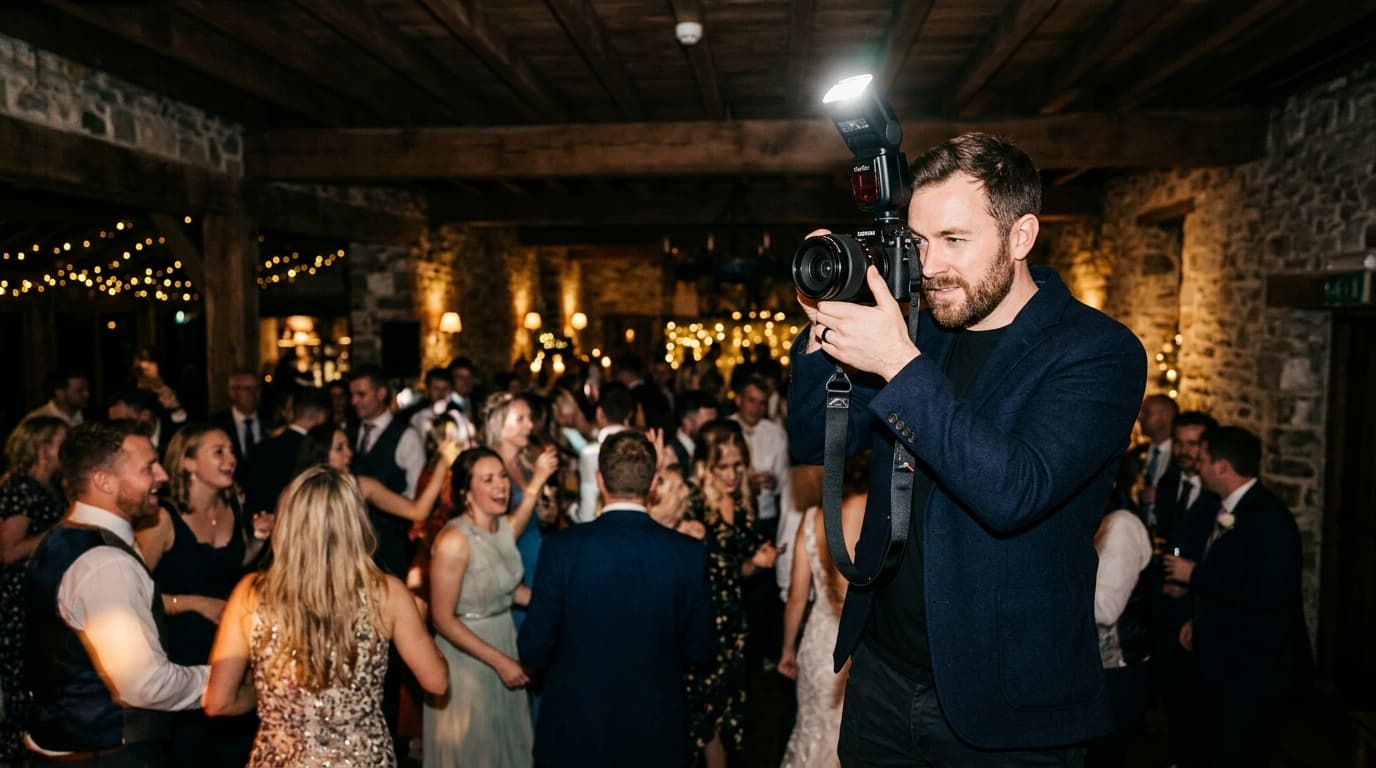
You handle difficult lighting at indoor venues without flash drama by reading the room first, bouncing off light-colored surfaces, exposing for ambient light before adding fill flash, and gelling your flash to match the room's tungsten or LED color temperature. This keeps images natural instead of looking flash-blasted, and the approach works whether you're shooting a wedding reception, a corporate gala, or a dim conference hall.
TL;DR
- Expose for the ambient light first, then bring in flash only as gentle fill — this single habit avoids the dreaded black-hole background.
- A half-CTO gel is the most versatile fix for mixed tungsten-and-LED venue lighting; carry one on every flash you own.
- A fast prime lens and a higher ISO solve most dim indoor rooms without touching flash at all.
How Do You Handle Difficult Lighting at Indoor Venues Without Flash Drama?
You handle difficult lighting at indoor venues without flash drama by treating flash as a supplement, not the star of the shot. Expose your camera for the ambient light in the room, underexposing it slightly, and only then add flash at low power to lift faces and fill shadows. This one sequencing change — ambient first, flash second — is the difference between photos that feel lit by a science experiment and photos that feel like they belong in the room.
The same logic applies whether you're shooting a reception under string lights, a product launch under moving LED wash, or a conference gala under low ceiling downlights. Once you stop asking your flash to do all the work, the room's own atmosphere stays visible in the frame.
Why Do Indoor Event Venues Create Such Difficult Lighting Situations?
Indoor venues create difficult lighting because they mix multiple, inconsistent color temperatures in the same space at the same time. Tungsten down-lights run warm around 3,200K, many modern LED fixtures sit anywhere from 2,800K to 3,500K, and DJ or stage lighting shifts color every few seconds, while your flash is daylight-balanced at roughly 5,500K.
High ceilings, dark drapes, and exposed wood beams make things worse because they give your flash nothing to bounce off, which is why photographers describe some rooms as eating a flash for breakfast. Add moving subjects — a first dance, a keynote speaker pacing the stage, guests dancing under strobing lights — and you're solving an exposure and a color problem simultaneously.
How Can You Bounce Flash Effectively When Ceilings and Walls Work Against You?
You bounce flash effectively indoors by testing the surfaces in the room before the moment matters, then aiming your flash at whatever reflects clean, neutral light. Fire a couple of test shots early in the evening in different directions and check both the shadow falloff and any color tint coming back off the bounce, since dark wood or colored drapes will cast an unwanted tint onto every face.
If you bounce your flash slightly behind you and to camera-left, you mimic soft window light that wraps naturally around faces and adds depth. When ceilings are too high or walls too dark to use, tilt your flash 45 degrees toward a pillar, a portable reflector, or a second off-camera flash set up purely as a bounce source — the goal is always to give the light something to reflect off, because firing into open black space wastes it entirely.
How Do You Avoid the Black-Hole Background Look Indoors?
You avoid the black-hole background by making sure your flash never overpowers the ambient light in the frame. That flat, cut-out look — subject perfectly lit, background gone — happens for one of three reasons: your shutter speed is too fast, your ISO is too low, or your flash power is set too high.
Fix it by dropping your shutter to around 1/125–1/160, raising your ISO to 1600–3200, and opening your aperture wide before you even turn the flash on. Take a test shot with flash off first; if the background looks reasonably visible, bring your flash in starting at 1/128 power and increase only as needed, since your job is to supplement the ambient mood, not erase it.
When Should You Use Off-Camera Flash Instead of Ambient-Only Shooting?
Off-camera flash earns its place when you need consistent, repeatable light on a moving subject in a room with unpredictable ambient conditions, such as a first dance, an award presentation, or a dance floor lit only by DJ or stage lighting. A common setup for dance floors uses four flashes positioned in the corners, pointed inward at low power, so subjects get front and rim light no matter which way they turn.
Ambient-only shooting works better when the atmosphere itself is the subject — candlelit vows, string-light receptions, or moody stage lighting where flash would flatten the mood. ShootProof's guide to shooting in dark venues recommends pushing ISO well into the thousands and relying on your fastest prime lens before reaching for flash in these softer-light scenarios, and only adding a low-power off-camera light as a subtle fill if faces still read too dark. Read the full breakdown at ShootProof's dark venue guide.
How Do Gels Help You Match Flash to Tungsten and LED Venue Lighting?
Gels help by warming your daylight-balanced flash so it matches the tungsten or LED light already filling the room, which keeps your subject's color tone consistent with everything behind them. A full CTO gel suits very warm, dim tungsten rooms; a quarter CTO adds a touch of warmth in mostly neutral spaces; and a half-CTO gel handles the mixed tungsten-and-LED lighting you'll find in most reception halls, ballrooms, and conference venues.
If you're shooting multiple off-camera flashes for a first dance or stage moment, gel every light the same way — an ungelled backlight next to a gelled key light produces mismatched warm-and-cool tones in the same frame. Set a custom white balance around 4,000–4,200K for a half-CTO gel so your in-camera previews stay accurate, which also saves editing time later if you're working through a structured post-event workflow.
What Camera Settings Work Best for Mixed Indoor Lighting?
Solid starting settings for mixed indoor lighting are a shutter speed between 1/100 and 1/160, an aperture between f/1.8 and f/4, and an ISO between 800 and 3200, adjusted based on how much ambient light you want visible. A fast prime lens matters here more than almost any other piece of gear, since even a good f/2.8 zoom lets in far less light than a nifty fifty at f/1.8; if you're rebuilding your kit around low-light work, our guide to the best lenses for wedding photography covers the fast primes worth carrying.
Set your white balance manually instead of on auto so results stay consistent across a sequence of shots, and shoot raw so you can recover shadow detail and fine-tune color casts during editing. Whatever your final settings, the priority order stays the same everywhere: expose for the room, add flash only as fill, and gel it to match.
How Does Solving Lighting Fast Change What Happens After the Event?
Solving lighting problems on location matters most because it determines how fast and how well you can deliver afterward — clean, well-exposed files cull faster, edit faster, and need less recovery work than a memory card full of black-hole shots or blown-out faces. That speed advantage compounds if you're also delivering photos to a large group quickly, whether that's wedding guests, conference attendees, or corporate event staff who want their photos the same week.
Once your lighting is dialed in and your files are clean, the delivery side gets simpler too. Tools like fast corporate photo delivery workflows and AI-powered face search — the approach FindMe Photo (findme.photo) uses to let every guest or attendee find and share their own photos in seconds, straight from an export in Lightroom Classic — only work as well as the photos you hand them, so nailing the light indoors is the first step in a much bigger reach strategy.
Frequently asked questions
What ISO should I use in a dark indoor venue without flash?
Start around ISO 1600 and push higher as needed; modern mirrorless cameras hold up well past 6400, and ShootProof notes many bodies perform adequately into the 16,000 range. A slightly noisy photo you actually captured beats a clean one you missed.
Do I need off-camera flash for dark wedding receptions or events?
Not always. On-camera bounce flash handles most dim rooms with usable ceilings or walls, but off-camera flash gives you more control for first dances, speeches, and party shots where you need consistent, directional light.
What gel should I put on my flash indoors?
A half-CTO gel is the most versatile choice and matches the mixed tungsten-and-LED lighting found in most indoor venues. Carry a full CTO for very warm rooms and a quarter CTO for lighter correction.
Why do my flash photos look like the background disappeared?
That black-hole look happens when your shutter speed is too fast, ISO too low, or flash power too high, so your camera never registers the ambient room light. Expose for the ambient light first, then add flash only as a gentle fill.
Can I ask the venue to turn up the lights for photos?
Yes, and you should. Most venues and event coordinators will happily brighten the room a notch for photography since nobody wants dark, unusable photos, and it also helps your camera's autofocus lock on faster.
Browse by topic
The new photo gallery for pro event photographers.
Expand your reach: 10× more guests open your galleries.
Why the whole room opens it
One link per event. No signup, no login, no app for your guests. Designed for mobile and access on the go.

Their face is their password. A selfie finds their photos in under 2 seconds. Selfie Search comes in every plan, including Free+.
They share it, or buy from your store. Your prices, your brand, your customers. Set up your store for digital and/or print copies connected to your Stripe.
Open your Free+ account today — every Growth feature free for 30 days — and onboard the fastest, coolest way to share your galleries.