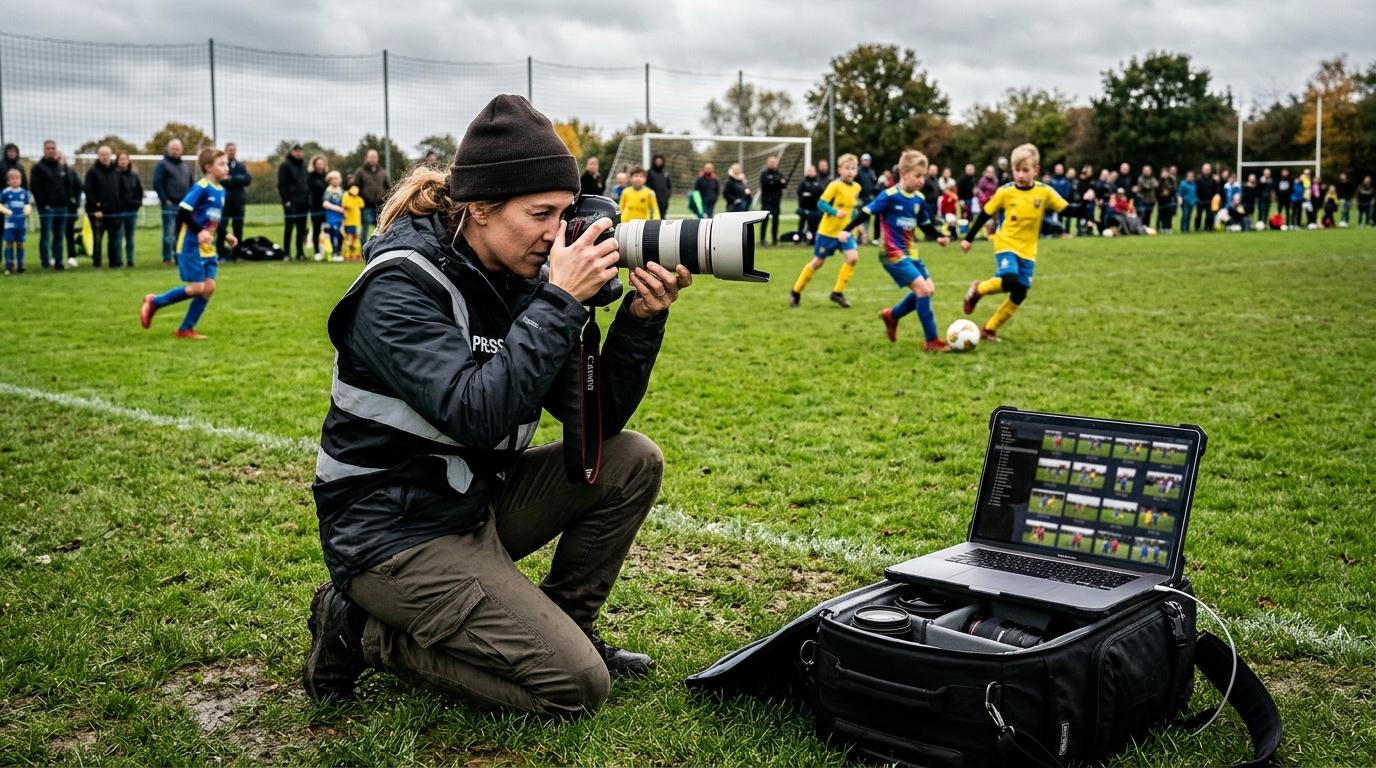
Youth sports photography consent privacy comes down to three things: written parent or guardian permission collected before the season, a working opt-out list that reaches you before you shoot, and tight control over where the images and any face data end up afterward. Get those right and you protect the kids, the league, and your business.
TL;DR
- Consent should be written, specific about use, and collected by the league at registration, with a clear opt-out you receive before game day.
- Opt-outs and withdrawals must be honoured every time, including after you've already shot and delivered.
- Face search on children is only defensible inside private galleries, started by a parent or guardian, with opted-out kids excluded and data deleted on a schedule.
This is a sensitive area, and the honest answer to many questions is “it depends on your jurisdiction and your league.” Nothing here is legal advice. What follows is a practical working standard that holds up when a worried parent emails you.
What does youth sports photography consent privacy actually require?
There is no single global rule, so the practical requirement is whatever your venue, your league, and your local privacy law combine to demand, plus a safeguarding standard you can defend. In practice that means written consent from a parent or guardian, a defined list of permitted uses, and a way to opt out.
Leagues handle this very differently. The Union City, NJ youth sports media policy (effective March 2025) treats participation as implied consent for promotional photos and asks families to opt out in writing before a program begins. Safeguarding bodies take a stricter line: the NSPCC's guidance on photography and filming in sports and activities (last updated November 2025) says clubs must have a photography policy, consent forms, and rules for storage and data protection.
As the photographer, you usually aren't the party that collects consent, but you are the one holding the camera. That means you should ask for the league's policy in writing, find out whether consent is explicit or implied, and decide whether you're comfortable working under it. If the policy is vague, tighten it in your own contract.
Who has to give consent for photos of minors?
A parent or legal guardian gives consent for a minor, and good practice also takes the child's own wishes seriously. The NSPCC guidance states that consent must be obtained for children under 16 and that everyone should be asked if they're happy to be photographed or filmed.
Two points from that guidance matter for working photographers. First, consent can be given or declined at any time, and wishes should be honoured regardless of previous consents. Second, the reasons for caution are concrete: the guidance lists risks such as children being identified for grooming, being identified by an existing perpetrator of abuse, and images being modified with AI and used inappropriately.
Families also have private reasons you will never hear about, like custody disputes, foster placements, or protective orders. That's why you should never argue with an opt-out or ask for a justification. A simple “understood, we'll exclude them” protects everyone.
How do you run opt-outs on the sideline without missing anyone?
You run opt-outs by getting a named list from the league before the event, converting it into something you can recognise at speed, and checking it again at culling and before delivery. A list in your inbox is useless at 8 a.m. with 14 teams rotating through four fields.
Here's a workflow that works for most youth leagues:
- Ask for the opt-out list 48 hours ahead, with team, jersey number, and a coach contact for each child, not just names.
- Brief coaches on the day so they can point out opted-out players, and consider a discreet league-chosen marker such as a colour of wristband, as long as the child isn't singled out in front of peers.
- Cull against the list. Tag opted-out kids by number during selection, and remove any frame where they are identifiable, including background shots. If you use AI culling on high-volume events, add a manual pass for this step because no tool knows who opted out.
- Keep a withdrawal path. Tell the league that a parent can withdraw consent mid-season, and commit to removing the images from galleries, downloads, and any search index within a stated window.
Be honest with yourself about group shots and crowd scenes. If an opted-out child is a small, unidentifiable figure in a wide frame, many leagues accept that, but you should confirm that rule with the league rather than assume it.
What should face search do with children's photos, and what should it never do?
Face search should only operate inside a private, access-controlled gallery, started by a parent or guardian, and it should never build a public or cross-event index of children's faces. Face templates are biometric data, and laws such as the EU and UK GDPR and Illinois' Biometric Information Privacy Act treat them as sensitive, so for minors the bar should be higher than for adult attendees.
There's also a practical wrinkle people gloss over. A parent's selfie won't find their child, so for youth sports the workable options are grouping by team, roster, or jersey number, or letting the parent supply a reference photo of their own child inside a gated gallery. For a closer look at the trade-offs, see bib number vs selfie search and how AI selfie photo search works.
A reasonable standard for any platform you use with minors:
- Should: require a gallery link or access code before any search, limit matches to that one event, exclude opted-out children from the index, let a parent request deletion, and delete face data after a fixed retention period.
- Should not: let strangers upload a child's photo to hunt for them, match faces across events or galleries, allow search engines to index the gallery, sell or reuse face data for anything else, or let children under 13 use the search themselves (the FTC's COPPA rule applies to online services collecting data from children under 13).
Some tools, including FindMe Photo, are built around private event galleries, which fits this model, but the settings differ by platform and by how you configure them. Ask any vendor, in writing, how face data is stored, who can trigger a search, and how deletion works before you point it at a youth league.
How should you store, share, and sell youth sports photos safely?
Keep youth sports photos in private galleries with access limited to the team or event community, avoid pairing faces with full names, and set expiry dates so images don't sit online indefinitely. Delivery convenience should never outrank safety here.
A few habits that reduce risk without making your service worse:
- Use captions with first names or numbers only, or nothing at all. Full name plus team plus location is exactly the combination safeguarding guidance warns about.
- Disable public indexing and unlisted sharing on galleries, and use a password or code distributed through the league.
- Strip location metadata from files and don't post real-time locations of practices or games.
- Consider download rules. Parents expect to download their own child's images, but think about whether web-resolution files, watermarks, or purchase gates fit your model. Our rundown of ordering software for youth leagues and the comparison of GotPhoto vs Zenfolio for school and sports cover how different platforms handle access and sales.
- Treat AI manipulation as a real risk. The NSPCC explicitly flags AI-modified images, which is another reason to avoid public, high-resolution, easily scraped posts of identifiable children.
Marketing use is a separate question. Consent to be photographed for a team gallery is not automatically consent for your portfolio, your Instagram, or a sponsor's ad, so get a specific release for each of those and honour takedown requests quickly.
What belongs in your contract and signage for youth sports shoots?
Your contract should state who collects consent, what uses are allowed, how opt-outs reach you, how long galleries and face data are kept, and what happens when consent is withdrawn. Put it in writing with the league, not just in an email thread.
Clauses worth including:
- The league warrants that it has obtained consent from parents or guardians and will send an opt-out list by an agreed date.
- You will exclude opted-out children from galleries, downloads, and any face search index.
- Withdrawals are honoured within a set timeframe, with the league as the single point of contact.
- Retention: galleries and biometric data are deleted after a defined period.
- Marketing use of any image of a minor requires separate written permission.
For broader language on usage rights, see our guide to event photography contracts and licensing, and check insurance, permits, and venue rules, since many parks, school districts, and facilities add their own rules for photographers working around children. Some also require background checks or credentials, so ask early.
On game day, a small sign at the registration table or on the field entrance helps too. It should say that photographers are working, how families can opt out, and who to contact. It's not a legal shield, but it reduces surprises and shows good faith.
FAQ
Do I need parental consent to photograph kids at a youth sports game?
It depends on where you are and who controls the venue, but the safest working rule is yes. Get the league or club to collect written parent or guardian consent at registration, and ask for the list of opt-outs before you shoot. Safeguarding guidance such as the NSPCC's says consent must be obtained for children under 16 and that it can be withdrawn at any time. This is general information, not legal advice, so check local law.
Can parents opt out of photos after the season has started?
Yes, and you should plan for it. Consent that can be given can also be withdrawn, and NSPCC guidance says a child's or parent's wishes should be honoured regardless of previous consents. Build a process that lets the league send you an updated opt-out list, then remove the affected images from galleries and any face index within a stated window such as 48 hours.
Is it safe to use face recognition on photos of children?
It can be, but only with tight limits. Face search should run inside a private, access-controlled gallery, be started by a parent or guardian rather than the public, exclude opted-out children, never match across events, and delete biometric data on a schedule. If a platform can't explain those controls in writing, don't use it for minors.
Can I post youth sports photos on my business Instagram?
Only if your consent covers it explicitly. Registration consent for a gallery or team keepsake is not the same as consent for marketing use. Get a specific release for promotional use, avoid naming children, never post live locations, and take images down quickly when a parent asks.
If you shoot youth leagues and want parents to find their own child's photos without public galleries or open indexing, FindMe Photo is worth a look, and you can check its privacy controls against the standard above before you decide.
Frequently asked questions
Do I need parental consent to photograph kids at a youth sports game?
It depends on where you are and who controls the venue, but the safest working rule is yes. Get the league or club to collect written parent or guardian consent at registration, and ask for the list of opt-outs before you shoot. Safeguarding guidance such as the NSPCC's says consent must be obtained for children under 16 and that it can be withdrawn at any time. This is general information, not legal advice, so check local law.
Can parents opt out of photos after the season has started?
Yes, and you should plan for it. Consent that can be given can also be withdrawn, and NSPCC guidance says a child's or parent's wishes should be honoured regardless of previous consents. Build a process that lets the league send you an updated opt-out list, then remove the affected images from galleries and any face index within a stated window such as 48 hours.
Is it safe to use face recognition on photos of children?
It can be, but only with tight limits. Face search should run inside a private, access-controlled gallery, be started by a parent or guardian rather than the public, exclude opted-out children, never match across events, and delete biometric data on a schedule. If a platform can't explain those controls in writing, don't use it for minors.
Can I post youth sports photos on my business Instagram?
Only if your consent covers it explicitly. Registration consent for a gallery or team keepsake is not the same as consent for marketing use. Get a specific release for promotional use, avoid naming children, never post live locations, and take images down quickly when a parent asks.
Browse by topic
The new photo gallery for pro event photographers.
Expand your reach: 10× more guests open your galleries.
Why the whole room opens it
One link per event. No signup, no login, no app for your guests. Designed for mobile and access on the go.

Their face is their password. A selfie finds their photos in under 2 seconds. Selfie Search comes in every plan, including Free+.
They share it, or buy from your store. Your prices, your brand, your customers. Set up your store for digital and/or print copies connected to your Stripe.
Open your Free+ account today — every Growth feature free for 30 days — and onboard the fastest, coolest way to share your galleries.