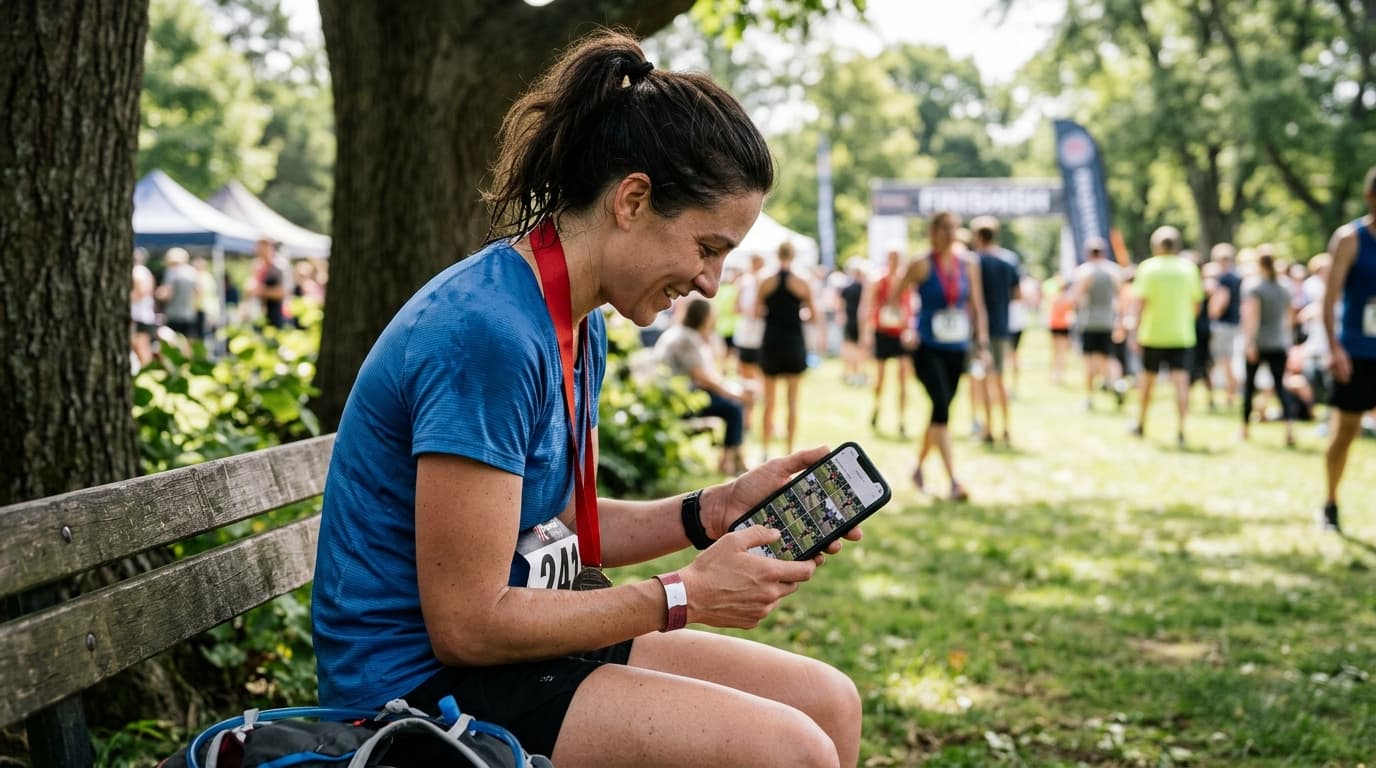
Runners type “find my race photos” into Google, then do one of two things: enter a bib number or upload a selfie. Bib search is fast and accurate when the number is readable, but turned, covered, or missing bibs break it, while selfie search matches the face instead. Offering both gets the most runners to the most of their photos.
TL;DR
- Bib recognition is excellent on clean, front-facing shots (vendors report roughly 95 to 98 percent), but it can't find a runner whose bib is hidden, turned, or absent.
- Selfie search fills the gap for obscured bibs, back and side views, and sports or fun runs with no bibs, though it needs a decent face in the frame.
- The strongest setup for a race photographer is hybrid: tag by bib where you can, and let runners search by face for everything else.
How do runners find my race photos: bib number or selfie search?
Runners find their race photos today through three routes: searching a bib number or name, browsing albums sorted by time and location, or uploading a selfie that an AI matches to their face. Most organizers still lead with the bib, because it has been the standard for years and it works well when the shot is clean.
Real race pages show how this plays out. The 2026 Silver Moon Race, held April 4 and 5, hosted more than 5,300 photos on RunSignup and told runners to search by bib number or participant name first. The same page warns that some photos don't show the bib because of a side view or an obscured number, so runners should browse the albums too.
That one note says a lot. The organizer knows bib search won't surface every photo, and the fallback is asking a tired runner to scroll through thousands of thumbnails. Some events now lead with both methods: the EPIC RACE MY gallery for the 2026 SCORE Marathon tells runners to upload a selfie or search by bib, whichever is easier.
If you shoot races, this matters beyond convenience. A runner who can't find their photos in the first minute doesn't buy, download, or post, and that is the end of the reach your work could have had. We cover the delivery side in more depth in how to share race photos so runners find themselves fast.
How accurate is bib number search for race photos?
On clean shots, bib recognition is very accurate, with tools commonly reporting 95 to 98 percent of readable bibs correctly tagged. That figure comes from vendors and depends on the conditions, so treat it as the best case rather than a promise for every race.
The best case is a front-facing runner, a flat bib at chest height, good light, and a shutter speed that freezes motion. Under those conditions, bib-first tools such as RaceTagger, ScoutFoto, FlashFrame, and MyRun are built to process thousands of frames quickly and attach a number to each one. If you want a closer look at one of them, our FlashFrame review covers how bib tagging behaves in a real workflow.
Bib search also has a real advantage on the runner's side. It is a single number the runner already knows, there is no privacy hesitation about uploading a face, and results appear instantly. For a 10K with thousands of finishers and a clean finish-line setup, bib tagging is hard to beat.
When does bib recognition fail?
Bib recognition fails whenever the number isn't cleanly visible to the camera, and that happens more often than most photographers expect during a race. The result is a runner who knows you shot them but can't find the frame.
The usual culprits are predictable, and most of them are outside your control:
- Turned or folded bibs: a pinned bib flaps, curls, or twists as the runner moves, especially at speed.
- Covered bibs: arms mid-stride, hydration vests, race belts, and jackets hide the number in cold or wet weather.
- Back and side angles: course shots from the side, plus action shots on climbs or turns, often show no number at all.
- Crowded packs: in the first kilometer, bibs overlap and only some are readable.
- Poor conditions: rain, dusk, shadow, and motion blur reduce legibility, which matters for evening and night events.
- No bibs at all: triathlon transitions where the bib is off, cycling events, obstacle races, charity fun runs, and team sports have no number to read.
Those misses are often the best photos, because the candid mid-race moment tends to be the one where the runner looks strong and the bib is turned. Race organizers know it too, which is why pages like Silver Moon's tell runners to browse albums after searching a number.
How does selfie search work for race photos, and where does it fall short?
Selfie search lets a runner upload one clear photo of their face, then uses AI face matching to return every photo of them across the event, whether or not a bib is visible. It solves the exact cases where bib tagging fails, and it works for any event where people aren't wearing numbers.
The method is simple for the runner: take a selfie, wait a few seconds, and see a personal gallery. There is no number to remember and no albums to scroll, which matters when the runner is standing in the finish area with a medal and a phone. We break down the technology in how AI selfie photo search works.
It has its own limits, and you should be honest about them with clients and runners. Selfie matching needs a face that is reasonably visible, so a runner with sunglasses, a cap pulled low, a buff over the mouth, or a face turned fully away is harder to match. Very small faces in wide course shots also give the system little to work with.
In practice the two methods fail in different places, and that is the point. Bibs struggle with angles and covering, while faces struggle with sunglasses and distance, so each catches most of what the other misses.
Which is better for race photos: bib search or selfie search?
Bib search is better for finish-line and checkpoint shots where numbers are clear and runners want speed, while selfie search is better for candid course photos, obscured bibs, and any event without bibs. Most race photographers get the best coverage by supporting both rather than choosing one.
Here is a practical way to think about it:
- Road races with timing chips and clear bibs: lead with bib search, add selfie search as the safety net.
- Trail runs, ultras, and cold-weather races: bibs are often covered by layers, so lead with selfie search.
- Triathlon, cycling, and obstacle races: bibs are inconsistent or absent, so selfie search does most of the work.
- Fun runs, charity events, and team sports: there may be no numbers, so selfie search is the main route.
- Multi-day or multi-location events: combine album filters with face search so runners can narrow by time.
If you also deliver for sports beyond running, our guide to the best photo delivery software for sports photographers compares how platforms handle both approaches.
How should race photographers shoot and deliver so runners can find their photos?
Shoot for readability first, then deliver with more than one search path so a missed bib never means a missed sale or share. Small changes in position and timing improve both bib and face matches at the same time.
Start with where you stand. Positions slightly ahead of the runner at a gentle angle capture the bib and the face together, while straight-on shots from a corner often catch neither. Use a shutter speed fast enough to freeze arm swing, because a blurred arm covers a bib just as well as a jacket does.
Then think about what you give the runner after the race. A single link that opens a face-search page, with album filters as a backup, is easier than a long list of folders. The sooner it goes live, the better: Motiv Sports tells runners its FinisherPix link usually arrives two to three days after the event, and by then plenty of runners have moved on from the race. For a wider view of this problem, see our guide to event photo delivery to attendees.
Finally, make sharing part of the flow. A runner who finds a great photo in ten seconds will often post it before leaving the finish area, and that post is your marketing. This is where a tool like FindMe Photo fits in: you upload once, runners find their own photos with a selfie, and every shared photo carries your work further than a bib-only gallery would.
Do you need a bib tool if you already offer selfie search?
You don't strictly need one, but bib data is still useful when your event has timing chips and organizers who want results linked to photos. Selfie search covers discovery, while bib tagging adds a precise, familiar lookup for the runners who prefer it.
The decision comes down to your clients. A big road-race organizer may expect bib numbers tied to the results page, whereas a trail series, a triathlon club, or a brand activation may care more about runners finding their photos with no effort. Match the tool to what the event promised its participants, and don't force a method on runners that adds steps.
Either way, the bar has moved. Runners expect to find their photos in seconds from a phone, and they will compare your gallery against the easiest one they have used before.
Frequently asked questions
How do I find my race photos without a bib number?
Use a selfie search if the gallery offers one. You upload a clear photo of your face and the system matches you across the whole event, so a turned, covered, or missing bib doesn't matter. If there is no selfie option, browse the albums sorted by time and location, such as start, mid-course, and finish.
How accurate is bib number recognition for race photos?
Vendors commonly report 95 to 98 percent accuracy on clean, front-facing shots where the bib is flat and fully visible. Accuracy drops on side views, bibs covered by arms, hydration packs, or jackets, and on shots taken in rain, shadow, or motion blur.
Why can't I find my race photos by bib number?
The most common reasons are that your bib was folded, covered, or worn on the back, the photo was taken from the side, or the photographer hasn't finished uploading and tagging yet. Race organizers often warn that side-view and obscured photos won't show up in a bib search, so check the albums too.
Is selfie search better than bib search for runners?
Neither is better everywhere. Bib search is quick and reliable when the number is visible, while selfie search finds the shots bibs miss and works in sports with no bibs at all. The best race galleries offer both, so the runner uses whichever is faster for them.
How long does it take to get race photos after an event?
It depends on the photographer and platform. Some galleries go live within hours, while others email a link two to three days later, as Motiv Sports describes for its FinisherPix galleries. Faster delivery generally means more runners find and share their photos while the race is still fresh.
Ready to let every runner find their own photos? FindMe Photo lets you upload once from Lightroom Classic or your AI assistant, and runners find themselves with a selfie in seconds, then share. Try it on your next race and see how far your photos travel.
Frequently asked questions
How do I find my race photos without a bib number?
Use a selfie search if the gallery offers one. You upload a clear photo of your face and the system matches you across the whole event, so a turned, covered, or missing bib doesn't matter. If there is no selfie option, browse the albums sorted by time and location, such as start, mid-course, and finish.
How accurate is bib number recognition for race photos?
Vendors commonly report 95 to 98 percent accuracy on clean, front-facing shots where the bib is flat and fully visible. Accuracy drops on side views, bibs covered by arms, hydration packs, or jackets, and on shots taken in rain, shadow, or motion blur.
Why can't I find my race photos by bib number?
The most common reasons are that your bib was folded, covered, or worn on the back, the photo was taken from the side, or the photographer hasn't finished uploading and tagging yet. Race organizers often warn that side-view and obscured photos won't show up in a bib search, so check the albums too.
Is selfie search better than bib search for runners?
Neither is better everywhere. Bib search is quick and reliable when the number is visible, while selfie search finds the shots bibs miss and works in sports with no bibs at all. The best race galleries offer both, so the runner uses whichever is faster for them.
How long does it take to get race photos after an event?
It depends on the photographer and platform. Some galleries go live within hours, while others email a link two to three days later, as Motiv Sports describes for its FinisherPix galleries. Faster delivery generally means more runners find and share their photos while the race is still fresh.
Browse by topic
The new photo gallery for pro event photographers.
Expand your reach: 10× more guests open your galleries.
Why the whole room opens it
One link per event. No signup, no login, no app for your guests. Designed for mobile and access on the go.

Their face is their password. A selfie finds their photos in under 2 seconds. Selfie Search comes in every plan, including Free+.
They share it, or buy from your store. Your prices, your brand, your customers. Set up your store for digital and/or print copies connected to your Stripe.
Open your Free+ account today — every Growth feature free for 30 days — and onboard the fastest, coolest way to share your galleries.