TL;DR
- Most photographers market to the couple. The untapped channel is the 117 guests sitting at every reception.
- Selfie search plus a QR code plus fast delivery means every guest sees their own photos and remembers your name.
- Done right, one 100-person wedding becomes 20 to 30 warm referral leads before the gallery email is even opened.
The referral math most photographers ignore
Every wedding has one couple and somewhere between eighty and two hundred other people in the room. The average US wedding in 2025 had 117 guests, according to The Knot's 2026 Real Weddings Study of roughly ten thousand couples, with Gen Z couples averaging 129.
That is the pool of people who just watched you work, who will be at other weddings in the next twelve months, and who have friends getting engaged — and none of them are getting your gallery link.
Referrals are already the single biggest source of new business in wedding photography, with surveys of working photographers consistently putting the number at around seventy percent of bookings. A referred lead converts at close to twenty percent compared with one to three percent on cold inbound, and referred clients are also roughly eighteen percent more loyal over time.
Almost every guide to wedding photography referrals optimizes the wrong variable: ask the couple better, incentivize the couple, follow up with the couple. The couple refers you once or twice and then goes on with their lives.
The guests are the channel. Most photographers ignore them because there is no easy way to reach them individually — selfie search is the easy way.
Why guest-first beats couple-first
The bride is not out at another wedding next weekend, but her bridesmaids are, her newly-engaged coworker is, and the cousin who liked your work on Instagram and has a best friend planning a destination wedding in 2027 is.
When the couple refers you, they refer you to maybe two people in the six months after their wedding, if at all. A guest refers you in the moment someone tells them they are engaged — and that person is at a wedding every other weekend. The referral lands at full volume because they literally just saw your work in action, with photos of themselves to prove it.
A photographer who shoots twenty weddings a year has twenty couples doing couple-referrals. That same photographer has roughly 2,340 guests doing guest-referrals — if those guests actually see their photos and know who to name. Most of them never do; they remember the wedding, but they never learn who made the pictures of it.
Warm referral leads per year, for a photographer shooting 20 weddings
Based on 20 weddings per year with ~117 guests each (The Knot 2026 Real Weddings Study). About 30 guests per wedding use selfie search, and each generates roughly 0.5 referrals over the following 18 months.
How selfie search closes the gap
Selfie search does one thing that fixes the discovery problem: it lets every guest find the photos they are in without scrolling through a gallery of hundreds of images they do not care about.
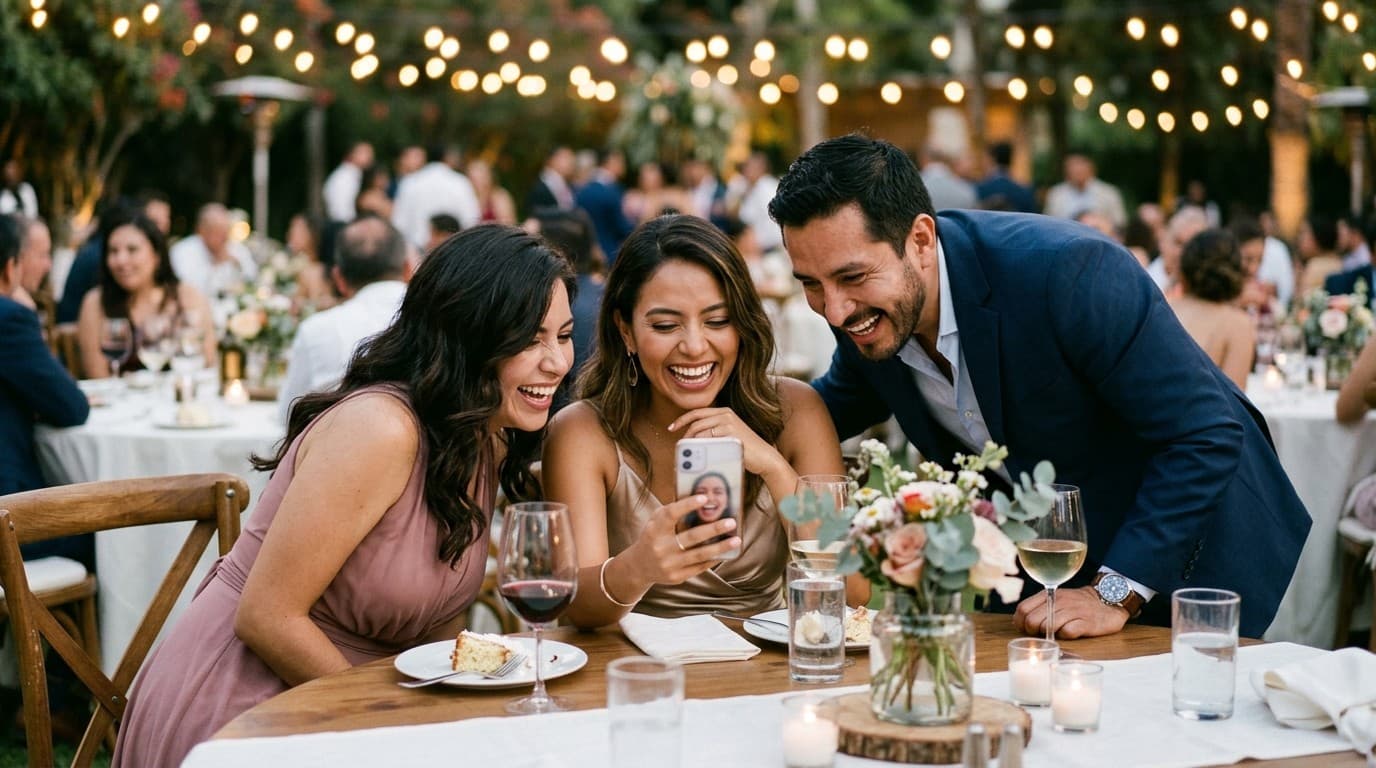
The guest scans a QR code, uploads a selfie, and gets a personal mini-gallery of the twelve to forty photos they appear in. The couple still gets the full archive; the guest gets a curated slice that is entirely about them.
Three things happen in that moment that never happen with a plain gallery link.
First, the guest sees themselves at their best on someone else's camera, which for most adults is a rare event. The emotional payoff is high enough that they save the photos, post them, and text them to their parents within the hour.
Second, the photographer's name is right there — not buried in a watermark or hidden in the gallery footer, but at the top of the page the guest just landed on, in the subject line of the email they received, and in the branded footer of the link they shared.
Third, the entire experience takes place during the forty-eight-hour window when the wedding is still the thing everyone is talking about. That is the emotional peak when photos get shared on social, forwarded in group chats, and remembered; outside that window, post-wedding attention drops off a cliff.
Traditional delivery misses all three: the gallery ships four to eight weeks later, only the couple downloads it, and the guests were never named on anything they saw.
The reception setup that activates guests
The mechanics are simple — there are only four moving parts, and getting all four right is what separates a wedding where thirty guests activate from a wedding where five do.
QR code signage at the reception
A 4x6 card on every table with a QR code and one line: "Your photos will be here tomorrow — scan to find yourself." The reception QR sharing playbook goes deeper, but the short version is that table signage converts roughly ten times better than an announcement over the microphone.
Same-weekend or 48-hour delivery
The galleries that get opened are the ones that arrive while the wedding is still being talked about, and if the gallery does not go live until Monday of the following week, most guests never come back to it. Fast delivery does not mean edited final files — it means the selectable gallery is live within forty-eight hours, with full edits following later.
Branded gallery header
The selfie-search mini-gallery every guest lands on should have your name and studio at the top — not a subtle logo, but your actual name, the city you work in, and a link to your portfolio. That is the piece that gets remembered.
A thank-you email to every guest with photos
When a guest uploads their selfie and gets matched, capture the email and send a one-sentence thank-you the next day with the direct link to their photos. This is not a marketing email — it is the most welcome email they will get that week, because it contains pictures of them, and the fact that it comes from you means they know exactly who you are.
Nothing in this playbook costs money. It costs about forty-five minutes of setup per wedding, assuming the selfie-search tool is already live on your account.
What this looks like over a year
A photographer shooting twenty weddings a year, with an average of 117 guests, has 2,340 potential referrers pass through their year. If twenty-five percent of those guests actually use the selfie search and see your name, that is 585 people walking away from a wedding knowing a specific photographer by name.
Most of them will never need a wedding photographer, but some will, and a small percentage will refer you within the next eighteen months. Even at a half-percent referral rate — one referral per two hundred activated guests — that is three extra inquiries a year from a channel that costs you nothing.
At a twenty percent conversion rate on referral leads, that translates to a wedding or two a year that would not have existed otherwise, which for most photographers covers the tooling cost for the entire selfie-search setup many times over.
The photographers who run this system consistently see a different pattern: guest-activated referrals do not spike all at once, they trickle in six, twelve, and eighteen months after the wedding as guests attend other weddings and get asked for names. The compound effect is the same one that planner referrals deliver — except the guest pool is a hundred times larger.
The couple refers you out of love; the guests refer you out of identification. You gave them a picture of themselves when almost no one else at the wedding did, and that is the kind of moment people remember.
Try the guest-first approach on one wedding
The easiest way to test this is on a single booking. Pick a wedding where the couple is already engaged in social sharing with friends. Set up the QR table cards, connect your gallery to a selfie-search tool, and send the next-day thank-you email with a direct link to each guest's personal photos. FindMe Photo is free for your first 30 days — enough runway to see whether guest-first delivery shifts your inbound inquiries within the following six months.
Frequently asked questions
Do I need to ask wedding guests directly for referrals at the reception?
No. Guest-driven referrals work because the selfie-search experience does the work for you. A guest scans a QR code, finds photos of themselves, sees your name on the gallery header, and remembers you organically. Asking for referrals at a reception is awkward and almost never works. Setting up a system that makes guests remember your name does.
Will the couple feel weird if I market to their guests?
Not if the experience is framed as a gift to the guests, not a sales funnel. The selfie-search setup is helping the guests find their own photos, which is something every guest actually wants. Your name being on the gallery header is the same as a credit on any other professional delivery. Couples appreciate it because their friends come back to them saying how cool the gallery was.
What if a guest does not want their photos findable via face recognition?
Reputable selfie-search platforms let guests opt out or request deletion, and the match only happens when the guest uploads their own selfie. Nothing is surfaced publicly. The couple's gallery remains private; guests only see photos that match a selfie they actively uploaded. Opt-out policies should be visible on the gallery landing page.
How long does it take to set up guest-activated delivery for a wedding?
About 45 minutes per event if your selfie-search tool is already connected to your gallery workflow. That includes uploading images, enabling face indexing, printing QR table cards, and drafting the post-wedding email template. The template only needs to be written once; after that, each wedding is closer to 15 minutes of setup.
Does this replace asking the couple for referrals?
No. Couple referrals still matter and should be part of the same post-wedding workflow. Guest referrals are additive. The couple refers you out of love one or two times; guests refer you out of recognition when they are at other weddings. Running both channels is how photographers build a booking pipeline that does not depend on paid ads.
Browse by topic
The new photo gallery for pro event photographers.
Expand your reach: 10× more guests open your galleries.
Why the whole room opens it
One link per event. No signup, no login, no app for your guests. Designed for mobile and access on the go.

Their face is their password. A selfie finds their photos in under 2 seconds. Selfie Search comes in every plan, including Free+.
They share it, or buy from your store. Your prices, your brand, your customers. Set up your store for digital and/or print copies connected to your Stripe.
Open your Free+ account today — every Growth feature free for 30 days — and onboard the fastest, coolest way to share your galleries.