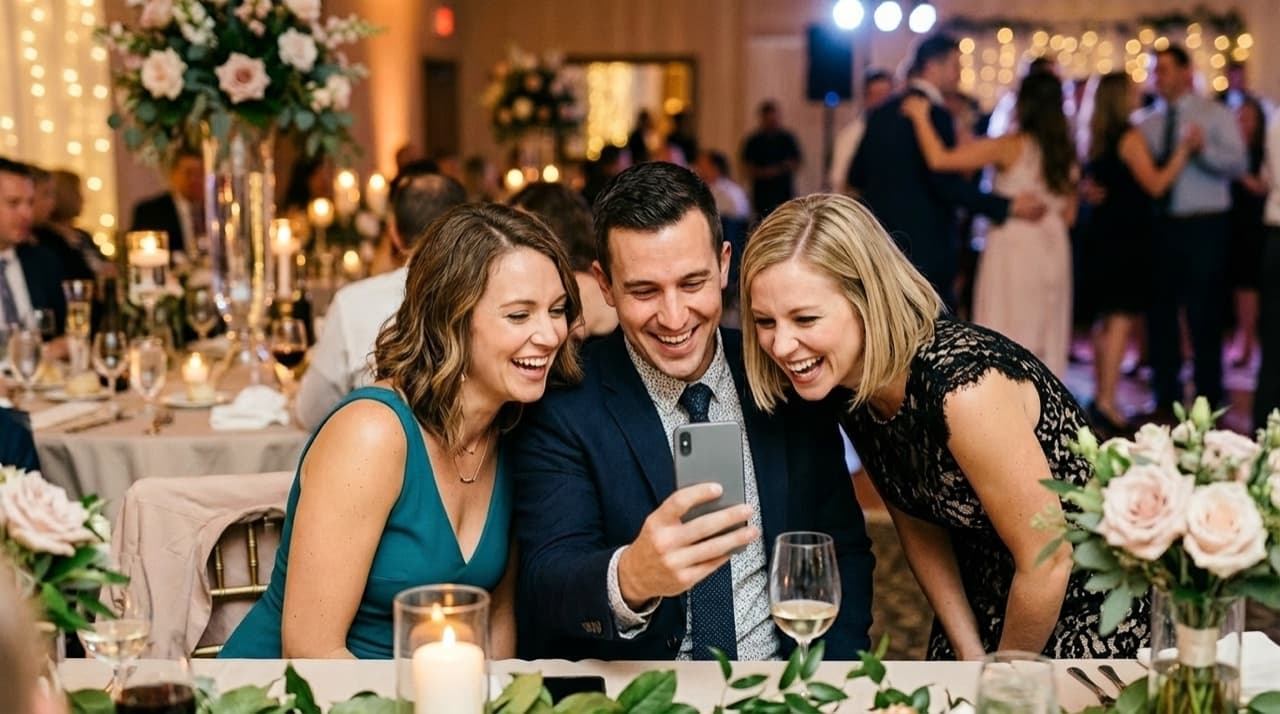
You've delivered the gallery. The couple is thrilled. You send the link, they forward it to 200 people, and then — nothing. Three weeks later the maid of honor emails asking if you can "just send the photos of the bridesmaids getting ready." The groom's dad calls asking for "the ones from the ceremony."
Your delivery worked. The problem was never the photos.
The scrolling problem nobody talks about
A gallery of 600 wedding photos is designed as an archive — one place where everything lives. But it's delivered to 200 people who each have a completely different relationship to those photos. The couple wants everything. The maid of honor wants the getting-ready shots and the first dance. Grandma wants the family portrait. The college roommate wants that one candid at the cocktail hour.
When you hand all 200 people a link to the same 600-photo wall, you're asking each of them to solve their own personal puzzle inside your complete archive. Most don't bother. They open the link, scroll for 45 seconds, close it, and move on. Research consistently shows that galleries with more than 300 images have significantly lower download rates per image than galleries with fewer — not because the photos are worse, but because the cognitive load of finding yourself in a crowd is simply too high.
This isn't a gallery problem. It's a discovery problem.
What actually happens to wedding photos
Most wedding photos live and die in a gallery link. The couple downloads them and backs them up. Their immediate family does the same. The other 180 people at the wedding — the ones who were there, danced, cried, gave toasts — never see a single photo of themselves. They remember the wedding. They just don't have proof they were there.
That's a loss for them. It's also a loss for you. Every guest who doesn't find their photos is a potential referral that doesn't happen. Every photo that doesn't get shared on social media is visibility you never got. The wedding photography industry runs almost entirely on word of mouth — and most of that word-of-mouth opportunity evaporates in the 48 hours after an event when photo excitement is highest and before the gallery problem sets in.
The 48-hour window
Wedding guests are most emotionally engaged with the event in the day or two immediately after. That's when they're texting each other, posting to Instagram, sharing stories. After 72 hours, the emotional peak has passed. After a week, most won't even notice they don't have photos.
Traditional delivery timelines — 4 to 8 weeks — are completely misaligned with this window. By the time a beautifully edited gallery arrives, the social moment has closed. The couple loves it. The guests have moved on.
The highest-impact change most wedding photographers could make isn't editing faster or shooting better — it's getting something shareable into guests' hands within 24 hours of the event, while the emotional context is still live.
A practical approach that works
The workflow that addresses this has two tracks running in parallel:
Track one is for the couple — a fully edited, beautifully presented gallery delivered in your normal timeline. This is what they paid for and what your reputation is built on. Don't rush it.
Track two is for the guests — a searchable version of your unedited or lightly-culled set, available the same night or the next morning. Not every photo. Not perfectly edited. Just the coverage, accessible via a QR code or short link that guests can use to find photos of themselves by taking a selfie.
AI face recognition tools have made this second track practical for any photographer. Guests scan a code, take a quick selfie, and the system returns the photos where they appear from your full coverage — typically in under 3 seconds. No account needed. No app. No scrolling.
The couple shows this QR code at the reception — on a sign, in the dinner menu, in the ceremony program. Guests use it during the event and in the days after. Your edited gallery arrives later, and the couple can share that separately.
What changes downstream
When guests find their photos easily, they share them. When they share them, your work reaches people who weren't at the wedding. When those people see beautiful candids from an event, they think about their own upcoming occasions. This is the organic referral loop that most photographers never fully activate because they never solved the discovery problem.
It also changes the conversation with clients. Being able to tell a couple "your guests can start finding their photos during cocktail hour" is a different pitch than "you'll have your gallery in 6 weeks." It's a tangible differentiator that shows up in every review they write and every recommendation they give.
Getting started
Try this at your next event. Upload your coverage to FindMe Photo, generate a QR code, and give it to the couple before the reception starts. The first 30 days are free — enough to know whether it changes your guest engagement. The setup takes about 3 minutes.
Your photos are good. More people should find them.
Browse by topic
The new photo gallery for pro event photographers.
Expand your reach: 10× more guests open your galleries.
Why the whole room opens it
One link per event. No signup, no login, no app for your guests. Designed for mobile and access on the go.

Their face is their password. A selfie finds their photos in under 2 seconds. Selfie Search comes in every plan, including Free+.
They share it, or buy from your store. Your prices, your brand, your customers. Set up your store for digital and/or print copies connected to your Stripe.
Open your Free+ account today — every Growth feature free for 30 days — and onboard the fastest, coolest way to share your galleries.