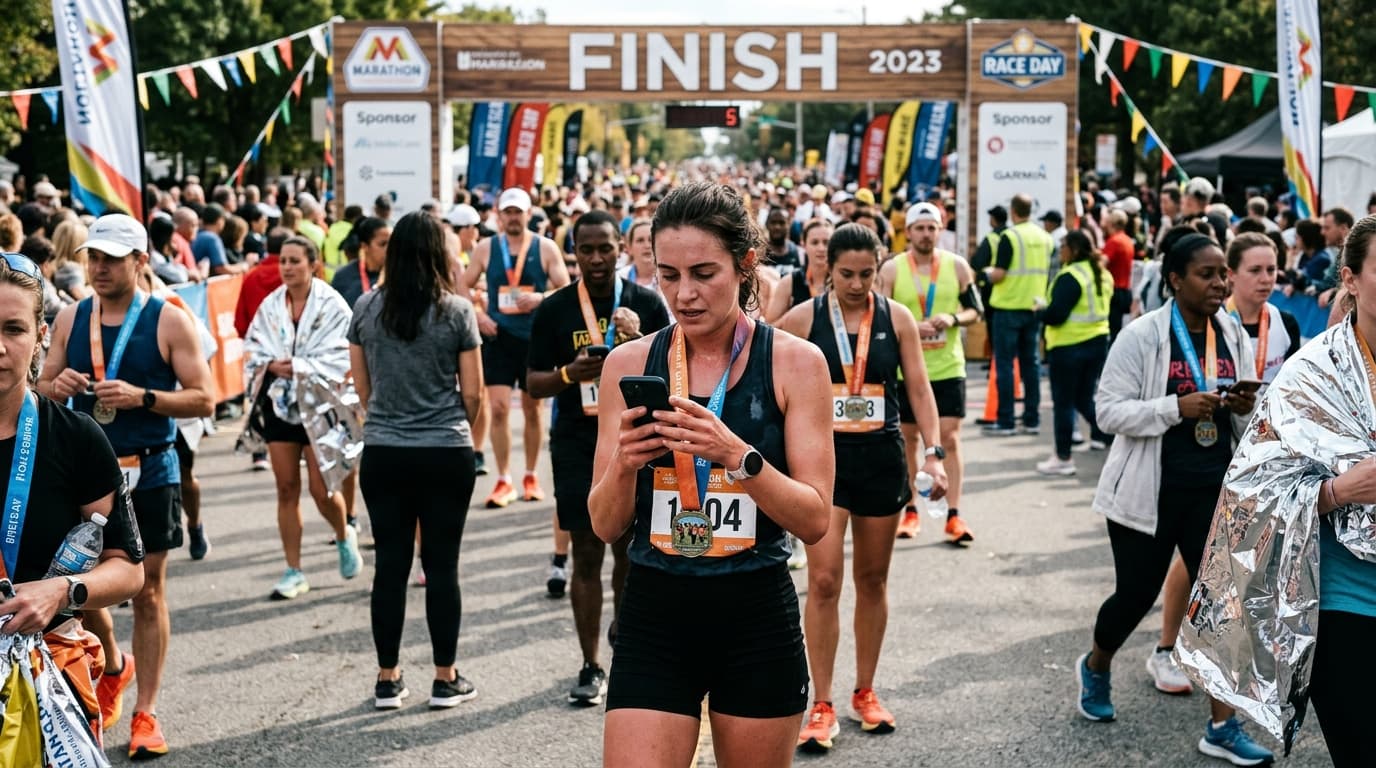
The fastest way to share race photos is to upload every image to a gallery with AI face or selfie search, then let each runner find their own shots instantly by scanning a selfie, searching a bib number, or tapping a link sent right after the race. This replaces hours of manual bib-by-bib sorting and can put a finisher's full photo set in their hands within minutes of crossing the line.
TL;DR
- AI face and selfie search, not manual folders, is what lets thousands of runners find themselves in seconds.
- Photographer placement matters as much as software: start line, 5K mark, hills, and the finish line each capture a different emotional moment worth sharing.
- Free search with paid downloads, sponsor-branded galleries, and registration bundles are the three revenue models that actually work for race photography.
How to Share Race Photos So Runners Find Themselves Fast
Sharing race photos so runners find themselves fast means removing every manual step between capture and delivery. In practice that means uploading images to the cloud during the event, running AI face recognition against every frame, and giving runners a selfie or bib search instead of a folder to scroll through.
Traditional delivery, where a photographer sorts thousands of images by hand after the race, simply can not keep pace with a field of 5,000 or 50,000 runners. Once face search is in place, a runner who crossed the finish line an hour ago can already be looking at every photo of themselves from the start chute to the medal table. If you want a deeper technical breakdown of how selfie matching works, this guide to AI selfie photo search covers the mechanics photographers actually need to know.
Why Is Race Photo Distribution Such a Challenge at Scale?
Race photo distribution is hard because the volume of images and runners grows far faster than any human sorting process can handle. A typical city marathon runs 5 to 15 photographer stations, draws 10,000 to 50,000 runners, and generates anywhere from 50,000 to 200,000 photos across the course, according to Kamero's marathon photo sharing research.
Multiply that by the fact that most runners only recognize themselves by a handful of visual cues, like bib color, shirt logo, or finish-line pose, and manual sorting quickly becomes unworkable. This is the same distribution problem festival and large-scale event photographers face, and the fixes overlap more than most photographers expect; see how festival photographers deliver photos to thousands of attendees fast for a comparable playbook.
Where Should Photographers Stand Along the Course?
Photographer placement determines what kind of moment you capture, and a good race gallery needs variety, not just finish-line shots. Cover the start line for group energy and anticipation, then post someone around the 5K mark while runners still look fresh and relaxed.
Scenic points such as bridges, landmarks, or park stretches produce the photos runners actually want to frame, while hill sections capture visible effort and determination that make for compelling shares. Reserve your strongest shooters for the final 500 meters and the finish line itself, where arms go up and relief turns into joy, and keep one photographer at the medal area for posed shots with finisher gear.
How Should Runners Access Their Photos After the Race?
Runners should be able to access their photos through more than one path, because not every participant will remember to check email or open a QR link. Selfie search at a kiosk or on their own phone works well right after finishing, bib number search serves as a reliable backup, and a direct notification link sent by email or text captures anyone who left the venue without searching.
Placing access points where runners naturally pause, like the finish chute, medal collection, hydration tables, or the results board, increases how many people actually find and share their photos instead of forgetting about the gallery entirely. For a broader look at how different events structure this handoff, this comparison of event photo sharing apps is a useful reference point.
Which Gallery Software Handles Race-Day Volume Best?
The gallery software that handles race-day volume best is the one that can ingest tens of thousands of images quickly and match runners to their photos without manual tagging. Platforms built around AI face search, real-time cloud upload, and mobile-first galleries are built for exactly this kind of spike, unlike tools designed primarily around slow-paced wedding-style delivery.
FindMe Photo runs from inside the AI assistant you already use and exports straight from Lightroom Classic, so a race photographer can shoot all day, export once, and let every runner find their own photos by selfie within minutes instead of waiting on a batch upload. If you are comparing established gallery platforms for volume events, this CloudSpot vs Pic-Time vs Pixieset comparison and this Pixieset vs ShootProof vs Pic-Time breakdown both walk through how each handles high-volume delivery.
How Can Race Photographers Turn Galleries into Revenue?
Race photographers typically make money by keeping search and preview free while charging for the parts runners actually want to keep. Free access with paid high-resolution downloads is the most common model, since it lets every runner find themselves without a paywall blocking discovery.
Sponsor integration is a second revenue stream worth pursuing directly with race organizers, since sponsors will often pay for branded galleries that put their logo on every shared photo. Bundling a photo package into race registration, or offering an annual pass to running clubs and repeat racers, adds recurring revenue on top of one-off sales.
What Race Photos Do Runners Actually Share?
Runners overwhelmingly share finish-line celebrations first, followed by scenic course shots, group running photos, medal moments, and effort shots that show visible strain on hills or the final stretch. Each of those shares on Instagram, Strava, or LinkedIn functions as free marketing for both the race and the photographer, since a runner's network sees the race brand every time a photo gets reposted.
Because sharing behavior is so predictable, positioning photographers to capture these specific moments, rather than shooting randomly along the course, directly increases how much of your gallery actually gets shared after the event ends.
Frequently asked questions
How do runners find their own race photos without a bib number?
Most AI-powered race galleries let a runner upload a quick selfie instead of typing a bib number. The system matches that face against every photo taken on course, at the start, and at the finish line, returning a personal gallery in seconds.
How fast can race photos be delivered to thousands of runners?
With cloud upload during the race and AI face search running in the background, many photographers can have searchable galleries live within hours of the last finisher crossing the line, compared to days or weeks with manual sorting.
Should I still print bib numbers on race photo signage?
Bib number search is still useful as a backup, especially for runners without a clear headshot, but selfie and face search now handle the bulk of lookups and reduce support requests from runners who can not find themselves.
How do race photographers make money if photo finding is free?
Most charge for high-resolution downloads or prints while letting runners search and preview for free, and many also sell sponsor-branded galleries or bundle a photo package into race registration.
What is the best way to notify runners their photos are ready?
Email or SMS with a direct gallery link sent within a day or two of the race, timed while post-race excitement and social sharing are still high, tends to drive the most opens and shares.
Browse by topic
The new photo gallery for pro event photographers.
Expand your reach: 10× more guests open your galleries.
Why the whole room opens it
One link per event. No signup, no login, no app for your guests. Designed for mobile and access on the go.

Their face is their password. A selfie finds their photos in under 2 seconds. Selfie Search comes in every plan, including Free+.
They share it, or buy from your store. Your prices, your brand, your customers. Set up your store for digital and/or print copies connected to your Stripe.
Open your Free+ account today — every Growth feature free for 30 days — and onboard the fastest, coolest way to share your galleries.