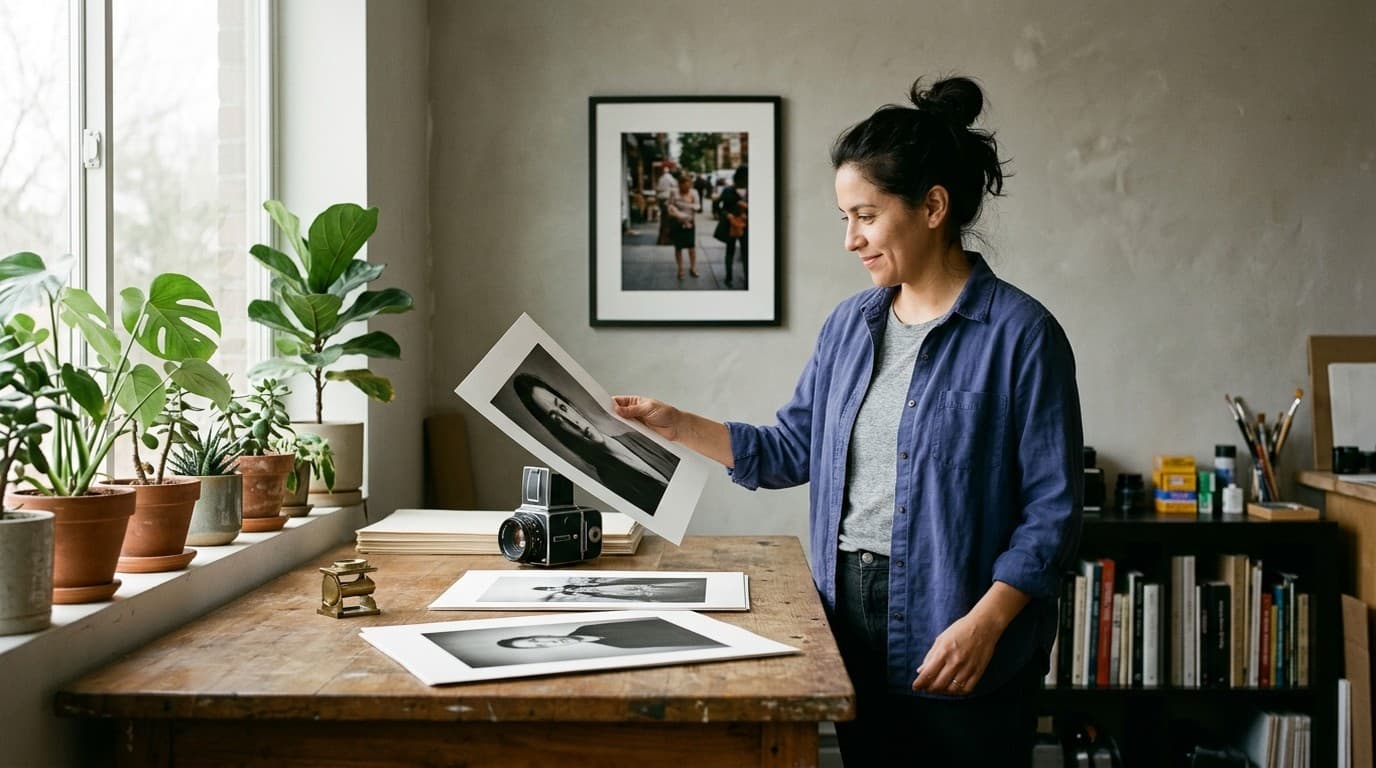
Photography print sales stop feeling like an upsell the moment you stop selling prints instead of the gallery and start selling them because of it. Your client already has the files. What they do not have is an idea of what to make from them, which is why most galleries end their life as a folder. Name the object — a framed enlargement, a canvas, a photo book, a collage wall, a poster taped together on a home printer — and the order follows.
TL;DR
- The digital gallery and the physical print do different jobs. Files get every photo to every person who was there; objects keep one photo visible in a room for years.
- Clients rarely order because nobody told them what to order. A short menu with one specific photo attached to each option converts far better than “let me know if you want prints.”
- For the clients who would rather do it themselves, a free image splitter turns any file into a multi-sheet poster on a home printer, on whatever paper they like, in about five minutes.
Why do prints and digital galleries work better together?
A gallery is distribution. It gets 800 photos to 200 people in an afternoon, lets each of them find the ones they are actually in, and turns a wedding into something the whole guest list shares. Nothing physical does that job, and no print run ever will.
A print is permanence. It keeps one photograph in front of a family every morning and in front of everyone who walks through their door, for as long as it stays on the wall. Nothing digital does that job either, which is the part photographers forget when they treat print sales as a separate line of business rather than the natural second half of delivery.
The demand is already there. The average consumer prints one out of every hundred photos they take, while 65% of consumers in the same 2026 report say they prefer physical photo albums for long-term memory preservation, and the photobook segment alone is forecast to reach USD 4.3 billion by 2030. People want the object. They just rarely get from the file to the object without help.
That gap is a logistics problem, not a pricing one. Rebuilding your price list will not fix it. Telling someone exactly what to make will.
What do clients actually make from a delivered gallery?
Six things account for nearly all of it. Put this list in front of a client and the vague intention to “print something one day” turns into a decision they can make in one sitting.
| What to make | Best kind of photo | Typical size | Who prints it |
|---|---|---|---|
| Framed enlargement | One hero frame, single subject, space around it | 16 x 20 in | Print lab or local framer |
| Gallery-wrap canvas | Wide landscape or a soft, low-detail scene | 24 x 36 in | Print lab |
| Photo book | The whole story, 60 to 120 frames in order | 8 x 10 in | Book service |
| Collage or grid wall | 6 to 12 small moments, mixed formats | 5 x 7 in each | Home printer or lab |
| Poster | Any frame with enough resolution behind it | 2 x 3 sheets and up | Home printer + free splitter |
| Everyday prints | Candid, funny, unposed | 4 x 6 in | Home printer |
Notice how little of that competes with what you deliver. A photo book is a curated version of a gallery nobody scrolls twice. A collage wall is the gallery's greatest hits, mounted. A poster is one frame promoted out of a folder. Each one gives the files a second life instead of replacing them, and each one keeps your work visible long after the link has stopped being opened. If you have read our piece on why photographers lose clients, this is the same mechanism running in reverse: work that stays in view keeps earning.
The choosing is the hard part, and it is the part you can do for them. You already know which frame carries the day. Say so.
How do you print a large photo at home?
Most clients assume anything bigger than a sheet of paper means a print shop, a minimum order, and a week of waiting. It does not. Any image can be split across several ordinary sheets and joined into a poster, and the whole job takes about five minutes on a printer that already sits in the house.
A free image splitter handles the splitting in the browser. You load the file, set the finished size in inches (or just say how many pages across and down), choose 150, 200, or 300 dpi, and download the result as a multi-page PDF or a zip of PNGs. It adds overlap margins and cut guides so the seams line up, and the files never leave the browser, which matters when the photo is of somebody's wedding. There is no signup and no upload step to explain to a client who is not technical.
Three things worth passing on with the link, because they are where home prints go wrong:
- Print at 100% or “actual size”, never “fit to page”. Fit-to-page silently rescales each sheet and the tiles stop matching at the seams.
- Match the paper to the plan. Matte photo paper behind glass, because gloss fights a frame under a lamp. Glossy for anything going on a fridge or a desk. Heavy card stock for a poster that hangs on its own without a frame.
- Send the highest-resolution file you have. A poster at 200 dpi needs far more pixels than a web-sized JPEG carries, which is a solid argument for delivering originals rather than compressed exports. If your gallery platform quietly downscales what clients download, this is where that shows up.
Splitting also solves the format nobody sells: the odd panorama, the two-metre banner for an anniversary party, the print sized to an awkward hallway. Those never make it to a lab order form, and they are exactly the kind of thing a client will do on a Saturday afternoon if you hand them the tool.
What should the follow-up email say?
One email, roughly six weeks after delivery. Not a promotion. A suggestion, with a specific photo in it.
Six weeks is the window where the photos are still emotionally live but the admin storm has passed, and the client has usually just noticed the gallery has gone quiet. Keep it short, because length reads as a pitch and a pitch gets archived.
Subject: That shot of your dad at the toast
Hi Sarah,
I was back in your gallery this week and frame 214 stopped me again, your dad mid-laugh during the toast. It would hold up beautifully at 16 x 20 above the stairs.
Three easy ways to do it: I can have it printed and framed for you, you can order it as a canvas, or if you want it on the wall this weekend you can split it across a few sheets and print it at home with this free tool. Happy to send the full-resolution file either way.
Congratulations again, it was a great day to shoot.
Four things are doing the work there. You picked the photo, so the client answers rather than decides. You named a size and a place, which removes the next two decisions. You gave three routes at three price points, including one that costs nothing, so a client who was never going to buy still ends up with your work on a wall. And you referenced a real moment, which proves you looked rather than mailed a template to your whole list.
If you want this to happen reliably rather than when you remember, it belongs in your event photography workflow as a scheduled step sitting right next to the delivery email.
Should you fulfil the prints or point clients elsewhere?
If you already sell prints, this framing is pure upside and costs you nothing to adopt. Your storefront stops being a checkout nobody visits and becomes the answer to a question you just asked. Platforms differ a lot in how much of that work they do for you, and it is worth reading how Pic-Time and Pixieset compare on print sales before you assume your current one is pulling its weight.
If you do not sell prints and do not want to, be honest about why: fulfilment is real work. Sourcing a lab, managing colour, replacing a parcel that arrived bent eight months after the wedding. Plenty of photographers, including the ones in our look at how six-figure photographers structure their businesses, deliberately skip it and spend the energy on making self-printing effortless instead. That trade is defensible. Both routes beat the default, which is delivering a gallery, hoping somebody prints something, and never raising it again.
For where print margin actually sits against everything else you charge for, our breakdown of what event photography costs in the US has the numbers.
None of this works if the files are hard to reach. Upload once to FindMe Photo and every guest finds their own photos by selfie search, then downloads them at the size you delivered. That is the raw material for every object on this page, in the hands of everyone who was there rather than one client with a download folder. Free for your first 30 days.
Frequently asked questions
What do clients do with digital photos after you deliver a gallery?
The ones who do something make objects out of them: a framed enlargement for a hallway, a gallery-wrap canvas, a photo book of the whole day, a grid of small prints on a wall, a poster printed at home, or 4 x 6 prints for a fridge and a desk. The gallery is what makes all of that possible, because it is the only place every photo from the day lives at the size it was delivered.
Do prints compete with a digital gallery?
No, they do different jobs. The gallery is distribution: it gets every photo to every person who was there, fast. A print is permanence: it keeps one image visible in a room for years. Photographers who treat the two as rivals usually end up doing neither well.
How do you print a large photo at home?
Split the file across several ordinary sheets and join them. A free image splitter does this in the browser: you set the finished size in inches, pick 150, 200, or 300 dpi, and download a multi-page PDF with overlap margins and cut guides. Print at 100 percent rather than fit to page, and the tiles line up.
Which photos are worth printing large?
Single-subject frames with a clear focal point and room around it. Wide reception shots full of small faces look great on a screen and disappear on a wall. A portrait, a first look, a hand on a shoulder, or one strong landscape holds up at any size.
Should you sell prints yourself or let clients print their own?
Both, and the second is not a lost sale. A fulfilled order earns you margin. A client who prints at home earns you a wall in a house that guests visit for a decade, which for a referral-driven business is often worth more than the margin was.
Browse by topic
The new photo gallery for pro event photographers.
Expand your reach: 10× more guests open your galleries.
Why the whole room opens it
One link per event. No signup, no login, no app for your guests. Designed for mobile and access on the go.

Their face is their password. A selfie finds their photos in under 2 seconds. Selfie Search comes in every plan, including Free+.
They share it, or buy from your store. Your prices, your brand, your customers. Set up your store for digital and/or print copies connected to your Stripe.
Open your Free+ account today — every Growth feature free for 30 days — and onboard the fastest, coolest way to share your galleries.